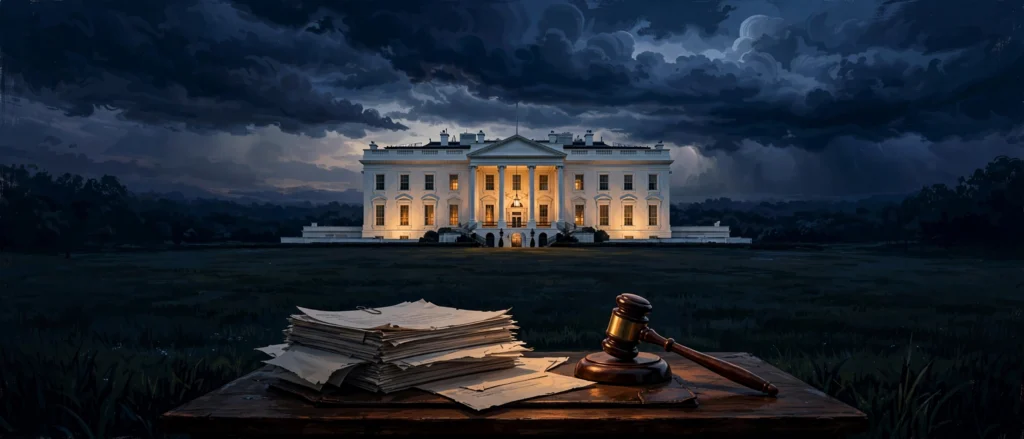
White House News: Trump Team Readies Fierce Probe Fight
The latest white house news from Washington is a warning shot. The White House, anticipating a surge of congressional oversight from a Democratic Congress, has started staffing up its counsel’s office, adding fifteen lawyers so far as it prepares for a legal battle that is expected to ramp up aggressively in January. The preparations have been under way for months, but the pushback has now gone public. On Wednesday, the White House released a letter from White House counsel Will Scharf accusing Democrats of making “abusive and capricious threats” that aim to “interfere with the lawful functioning of government” — and suggesting that the investigations themselves might cross the line into criminal conduct.
The letter, addressed to Representative Robert Garcia of California, the top Democrat on the House Oversight Committee and the man expected to chair the powerful panel in the new Democratic-controlled Congress, made clear that the administration would resist congressional subpoenas on the grounds that they lack a “legitimate legislative purpose.” It went further, saying that “threats to executive branch officials designed to deter them from public service, or process designed merely to abuse or instill fear in the recipient may cross the line into blatant criminality.” The message was unmistakable: the White House intends to fight the coming investigations in court, in public, and, if necessary, by investigating the investigators.
The confrontation sets up one of the most consequential clashes between the branches of government in years. Democrats won control of both the House of Representatives and the Senate in the midterm elections of November 3, and with those majorities comes subpoena power in both chambers — the power to compel the production of documents and the testimony of witnesses. The new Congress convenes on January 3, and the investigations are expected to begin almost immediately. “The last time around, Dems were very deliberate about pacing subpoenas,” said Brandon Rios, who was counsel to Democrats on the House Oversight Committee and now co-leads the congressional investigations group at the law firm DLA Piper. “This time, I’d be shocked if we don’t see them in January.”
White House news: the letter that fired the first shot
The Scharf letter was the opening move in a confrontation that had been building since election night. Garcia, who is expected to take the Oversight Committee gavel in January, had warned Trump officials to “lawyer up” as his party was on its way to its midterm victories. Scharf’s reply, dated Monday and released on Wednesday, was the White House’s answer. It accused Democrats of threatening executive branch officials, and it framed the planned investigations as an attempt to intimidate public servants rather than a legitimate exercise of congressional oversight. Outside the Capitol on Wednesday, Garcia told reporters that “Donald Trump is clearly hiding something” and that Democrats “are not going to be threatened or intimidated.”
The letter’s existence was first reported by Punchbowl News, and its language has already become a flashpoint. For the White House, the claim that congressional threats could amount to “blatant criminality” is a line in the sand, a signal that the administration will treat aggressive oversight as an abuse of power and respond in kind. For Democrats, it is evidence of exactly what they say they intend to investigate: a White House that regards scrutiny itself as illegitimate.
The preparations inside the White House began well before the election. David Warrington, then the incoming White House counsel, began planning for congressional oversight hearings as far back as the presidential transition in 2024. That work picked up this year as White House lawyers realised that Republicans could lose the House. Lawyers from the counsel’s office have been meeting with agency general counsels for months to plan how to respond to congressional inquiries, according to a person familiar with the preparations who spoke on the condition of anonymity because they were not authorised to speak on the record. Scharf, who replaced Warrington as White House counsel in September, has taken the planning further. “He is preparing the strongest, sharpest legal oversight team in the history of the country,” said Hunter Morgen, a former special assistant to the president for policy and strategy. “This administration will not back down in protecting the innocence of the great patriots working every day to preserve our republic.” The strategy, as described by people close to the White House, is simple. “I think the strategy, for lack of a better term, is ‘fight, fight, fight,'” one former official said. Trump’s choice of Stephen Miller as his chief of staff also suggests a combative posture. “Stephen will want to be directly engaged in this,” said a former official who spoke on the condition of anonymity to discuss internal deliberations.
Congress: what Democrats plan to investigate
Democrats have already signalled where some of their inquiries could go, and the list is long. They have indicated that they intend to examine immigration enforcement, the administration’s handling of Jeffrey Epstein-related records, White House construction projects, and financial dealings involving Trump associates. They are also expected to look at the Iran war, government spending, and the business dealings of the president, his family and the most influential members of his administration. The investigations are expected to seek information about the workings of Trump administration officials and others close to the White House since January 2025.
The first concrete steps have already been taken. On November 5, Senator Richard Blumenthal of Connecticut, the ranking Democrat on the Senate Permanent Subcommittee on Investigations, renewed requests for records from donors to the White House ballroom, including defence contractors Palantir and Lockheed Martin. He asked recipients to begin producing records by November 30 and said the subcommittee would look for other ways to obtain them if the donors failed to comply voluntarily by January 4. The ballroom, a major construction project at the White House funded in part by private donors, has become an early symbol of the questions Democrats want answered about the intersection of private money and public power.
The scope of the planned inquiries goes well beyond a single building. Democrats have said they want to examine how Trump and his family have become wealthier since he returned to office, and whether private commercial relationships created privileged access to decisions involving national security. With control of both chambers, they can run parallel investigations in the House and the Senate, call the same witnesses before different committees, and keep the pressure on the administration from multiple directions at once.
The prospect of sustained clashes has already rippled beyond Washington. Private companies and law firms are building up their staffs to prepare for an onslaught. Advisers and allies to President Donald Trump have lawyered up. K Street lobbying firms are readying for questions from congressional committees looking to probe their ties to an administration that has not shied away from its image of being open for business.
Trump administration: a defence planned since 2024
The White House’s legal preparations rest on two pillars: staffing and legal theory. On staffing, the fifteen new hires in the counsel’s office are only the most visible part of a broader build-up. White House attorneys have been coordinating with lawyers across federal agencies for months, briefing political appointees and agency heads on how to respond to congressional inquiries, document requests and subpoenas. The goal is a coordinated response, in which every agency follows the same playbook when the letters and subpoenas start arriving in January.
On legal theory, the administration has been assembling the arguments it will use to resist. Beyond arguing that congressional probes lack a valid legislative purpose, an August opinion from the Justice Department’s Office of Legal Counsel previewed another claim the administration is likely to make. The office concluded that executive privilege can shield communications even with advisers outside government when they concern official presidential decisions and involve the president or his direct aides. That opinion matters because many of the people Democrats want to question — including the president’s family members and business associates who have served as envoys and advisers — fall into precisely that category. If the administration can extend privilege to conversations with outside advisers, it can block a significant share of the testimony Democrats are seeking.
Even if the administration’s legal challenges ultimately fail, they may still succeed in their practical purpose. Litigation challenging subpoenas or other demands could take years, running out the clock until the end of Trump’s term, attorneys close to the White House said. “There’s a lot of talk about lessons that congressional Democrats learned conducting oversight during the first Trump administration,” said Peter Rechter, a partner at the law firm Wiley Rein and an associate counsel at the White House during the Biden administration. “But Trump administration officials learned lessons too. And I think one of those lessons is that litigation can be a powerful tool to slow things down.” With Trump scheduled to leave office in January 2029, a legal fight that lasts two years is, from the White House’s perspective, a legal fight that the administration has effectively won.
Democratic party news: the lessons of the first Trump term
Democrats, for their part, say they have learned their own lessons from the first Trump administration, when the White House slow-walked document requests and fought subpoenas in court for years. This time, they intend to move faster. Rios, the former Democratic Oversight counsel, said the party would not repeat the deliberate pacing of the past. “This time, I’d be shocked if we don’t see them in January,” he said of the subpoenas. The message from Democratic leaders is that the investigations will begin the moment the new Congress is seated, and that the White House’s warnings will not slow them down.
One of the Democrats’ most important strategic choices is where to aim. Private companies may be less willing than the White House to spend a year or more litigating while facing public accusations that they are obstructing Congress, Rechter said. Because of that, lawmakers are likely to seek records from companies that dealt with the administration. “I would expect Democrats to pursue maximum pressure,” Rechter said. “And as part of that, they may look to the private sector for parties who are not going to be comfortable litigating for a year or risk taking a reputational hit.”
What happens next is now a matter of the calendar. The new Congress convenes on January 3, and the first subpoenas are expected within weeks. Blumenthal’s ballroom records request sets an early test: donors have until November 30 to begin producing records voluntarily, and until January 4 before the subcommittee looks for other ways to obtain them. The Scharf letter has already established the White House’s position — that it will resist subpoenas it considers to lack a legitimate legislative purpose, and that it regards threats against executive branch officials as potentially criminal. The courts will eventually decide whether that position holds. In the meantime, Washington is preparing for two years of hearings, lawsuits and public confrontations, with the balance of power between the presidency and Congress itself at stake.
Source: The New York Times