SpaceX News: Starship Reaches Orbit, Booster Catch Aborted
The latest spacex news from the Texas coast is a story of two very different halves. SpaceX launched the 15th test flight of its giant Starship rocket on Friday evening, sending the spacecraft into orbit on a mission designed to become the first round trip in the programme’s history. But only minutes after liftoff, an unspecified problem forced flight controllers to abandon the planned recovery of the Super Heavy booster, diverting it to a splashdown in the Gulf of Mexico instead of guiding it back into the launch tower’s mechanical arms. The spacecraft itself pressed on without apparent trouble, reached orbit, released its cargo of satellites, and is now circling Earth ahead of a return attempt on Saturday that could still make history.
A Launch Aimed at the First Round Trip
Starship lifted off from SpaceX’s Starbase complex near Brownsville, Texas, at 4.47pm Central time on Friday, 5.47pm Eastern, inside a 75-minute launch window, after the company received authorisation from the Federal Aviation Administration earlier in the day. The vehicle, the largest and most powerful rocket ever flown, stands 124 metres tall and is driven at liftoff by 33 Raptor engines on its Super Heavy first stage, producing about 17 million pounds of thrust. It is the 15th Starship test flight since the programme began in 2023, and the second to carry a batch of operational Starlink satellites into orbit rather than dummy cargo.
The ambition of this flight was greater than any before it. SpaceX planned to recover both stages of the rocket at the launch site: the Super Heavy booster returning minutes after liftoff to be caught by the tower’s giant mechanical arms, and the Starship spacecraft itself returning from orbit almost a day later for a similar catch. No rocket system has ever been recovered this way in full. A complete round trip would be a decisive step towards the fully reusable system that SpaceX says is needed to make spaceflight routine, and to carry people and cargo to the Moon and eventually to Mars.
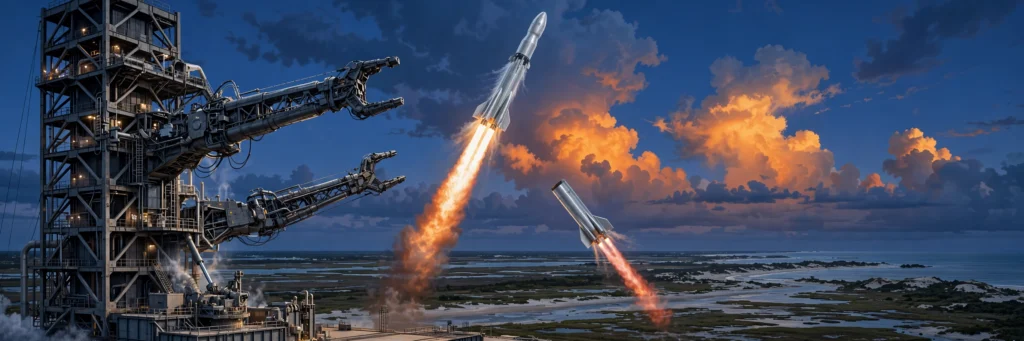
The launch site itself is part of the story. Starbase sits on the Gulf coast at Boca Chica, a remote stretch of south Texas that SpaceX has turned into its main Starship base. The tower’s arms, nicknamed chopsticks, are the centrepiece of the recovery system: two giant steel arms that close around a returning rocket and hold it in mid-air.
Booster Catch Aborted After Liftoff
The first half of that plan unravelled within minutes. After liftoff and the separation of the two stages in mid-air, an issue with the Super Heavy booster forced SpaceX to call off the catch attempt and send the booster to an offshore splashdown instead. SpaceX did not immediately explain what had gone wrong, saying only that the decision was taken for safety reasons. Observers at Starbase could hear the sonic boom and see the fiery plunge as the booster came down in the Gulf of Mexico about six and a half minutes after launch, ending its flight in the sea rather than in the tower’s arms.
The setback was a real disappointment for a programme that had already caught the booster three times on earlier test flights, and for a mission that was meant to deliver a first: the simultaneous recovery of both stages. The booster catch has become the signature image of the Starship programme, a tower’s arms plucking a falling rocket out of the sky, and each successful catch has been treated as proof that the reusability concept works at a scale never attempted before. Losing this one to the sea does not change the physics, but it does mean the double catch will have to wait for another flight.
There was also a complication on the ground. Hours after the launch, the Federal Aviation Administration issued a nationwide ground stop after reporting communication problems, although it said the SpaceX licence was unaffected. The timing was awkward, coming on the same evening as one of the year’s most watched launches, but the regulator’s statement made clear that the Starship flight itself was not the cause of the stoppage and that its authorisation stood.
Starship Reaches Orbit and Deploys Its Satellites
While the booster was coming down in the Gulf, the spacecraft that gives the rocket its name was climbing. About 26 minutes after launch, Starship completed a second engine burn lasting about 20 seconds and settled into low Earth orbit at an altitude of about 275 kilometres. It was only the second time a Starship has reached orbit, after Flight 14 on September 28, and it confirmed that the vehicle’s core task, getting to space and staying there, is now repeatable.
Once in orbit, the spacecraft began the other job it had been sent to do. Starting about 36 minutes into the flight, it released 26 of SpaceX’s most advanced Starlink satellites, the V3 generation of the company’s broadband constellation, in a deployment operation expected to take less than an hour. It was the second flight to carry operational Starlink satellites, a sign that Starship is moving from pure experiment towards the working role its builders always intended: a heavy-lift freighter for the satellite network that funds much of the company’s ambitions.
SpaceX said several hours into the mission that the spacecraft and its heat shield were healthy as the vehicle continued to orbit Earth. The plan calls for the ship, known as Ship 42, to circle the globe 14 times over more than 22 hours, testing its systems in sustained flight before attempting the return. That long stay in orbit is itself a test: earlier Starship flights were measured in minutes or a few hours, and keeping a vehicle healthy through a full day in space, with its heat shield intact and its engines ready to fire again, is part of what a working spacecraft must prove.
NASA News: The Moon Is Riding on Starship
The stakes of the flight extend well beyond SpaceX. NASA is counting on a Starship-based system to land astronauts on the Moon, with the first crewed landing aimed for as early as 2028 under the Artemis programme. The agency’s administrator, Jared Isaacman, noted the mission in a post on X that drew attention to video sent down from orbit through the Starlink network. For NASA, each Starship flight is not only a SpaceX experiment but a rehearsal for the vehicle that is supposed to carry its astronauts to the lunar surface.
That is why the orbital flight matters even with the booster lost. A lunar lander must be able to reach orbit, operate there for an extended period, and come home safely, and Flight 15 is testing all three. The heat shield, the engines, the long-duration systems and the return manoeuvre are the same ones a Moon-bound Starship would need. A successful catch of the ship on Saturday would be the clearest evidence yet that the system can be recovered and flown again, which is the foundation of the cost case for using it on Artemis.
Elon Musk News: Reusability and the Road to Mars
For SpaceX’s founder, Elon Musk, the flight is a test of the idea on which the whole Starship programme rests: that a rocket can be flown, caught, refuelled and flown again, the way an aircraft is. The 14 flights before this one all ended with the spacecraft in the ocean, whether by design or in wreckage, and the company has been open that the path to full reusability would be learned in public, one failure at a time. The booster catches already achieved showed the first stage could come home. The ship’s return, if it works on Saturday, would close the loop.
The Starlink deployment is the commercial side of the same story. The V3 satellites are larger and more capable than earlier generations, and only a rocket of Starship’s size can carry them in the numbers SpaceX wants. Every successful orbital flight that also delivers satellites is a step towards the point where Starship pays for itself, launching the constellation that in turn funds the development of the rocket. That is the business model behind the spectacle: a satellite freighter that doubles as a Moon ship and, one day, a Mars ship.
The first Starship flights ended in explosions minutes after launch, and each test since has pushed further: a first stage separation, a first booster catch, a first orbital flight, and now a first attempt at a full round trip. The pace has been fast by the standards of rocket development, and the failures have been public, but each flight, including the ones that end in the sea, teaches the company something the next flight uses.
What Happens Next: Saturday’s Catch Attempt
All attention now turns to Saturday afternoon, when the spacecraft is due to return to Starbase after more than 22 hours in space. SpaceX plans to bring it back at about 3.20pm Central time for an attempted catch by the launch tower’s mechanical arms, the first time a spacecraft has ever been recovered this way after returning from orbit. If it works, Flight 15 will still have made history, becoming the first mission to fly a full round trip from the launch pad to orbit and back to the same pad.
There is still a fallback if the final approach does not look safe. The mission team can end the flight early and send the ship to a controlled splashdown in the ocean, the outcome that ended all 14 previous flights. That option is a reminder that the return is the riskiest part of the mission: a vehicle coming back from orbit must survive re-entry heating, steer itself to a precise point, and then be caught in mid-air by arms that have never held a returning spacecraft before.
Whatever happens on Saturday, the flight has already moved the programme forward. A second orbital flight, a clean satellite deployment and a long-duration stay in space are all milestones that stood between Starship and its intended working life. The booster catch can be tried again on the next flight. The ship’s return is the prize this mission still holds, and by Saturday afternoon the world will know whether the boldest test flight SpaceX has ever attempted ends with a catch, or with another splash in the sea.
Source: CNN