Trump News: ASEAN Summit in Manila, Trump Joins Talks
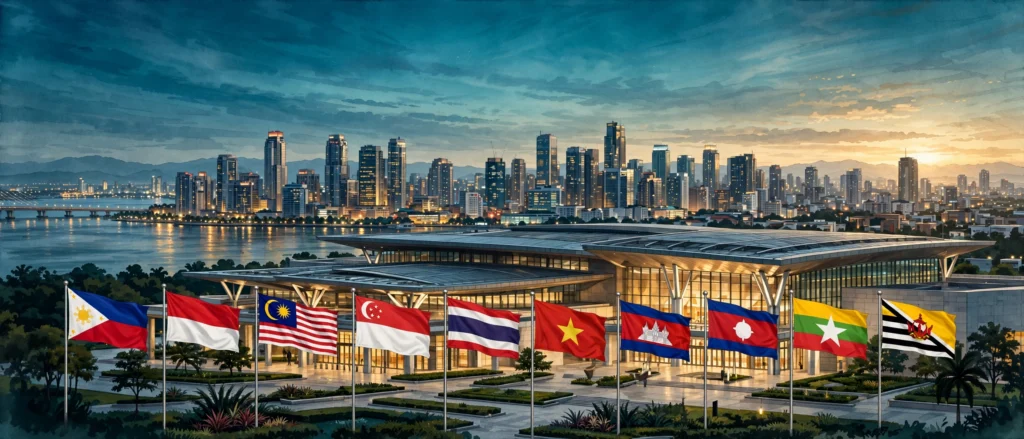
In the latest Trump news from Asia, Southeast Asian leaders are gathering in Manila for a three-day summit that puts peace, energy and the South China Sea at the centre of the agenda. President Donald Trump is due to join the final talks on Tuesday, November 17. The meeting, the 49th summit of the Association of Southeast Asian Nations, opens on Sunday, November 15, and closes the Philippines’ year holding the bloc’s rotating chair. It is the last full gathering of the region’s leaders before the chair passes to Singapore.
Trump will attend the ASEAN-US Special Summit on November 17, the closing event at the Philippine International Convention Center. The Department of Foreign Affairs confirmed the plan on Wednesday, November 11. It will be his first ASEAN gathering in the Philippines since 2017. From Manila he is scheduled to travel on to China for the Asia-Pacific Economic Cooperation summit in Shenzhen. Leaders in Manila are expected to call for peaceful resolutions to the conflicts weighing on the region.
Foreign ministers from the bloc began their own talks in Manila on Saturday, November 14, working through a shared response to rising energy costs, security tensions and an approaching El Nino weather pattern. The summit opens on Sunday with plenary and retreat sessions, where the leaders will review the Philippine chairmanship and take up Myanmar. The government has declared November 16 to 18 special non-working days across Metro Manila.
Trump news: what the Manila summit is expected to decide
The agenda in Manila is unusually crowded. The war in the Middle East will be the most urgent issue on the table, according to the Philippine chairmanship, because its fallout has reached deep into the region’s economies. The leaders are expected to discuss new measures for the energy crunch, including a possible emergency fuel-sharing arrangement and a regional oil stockpile. They will also review the long-delayed South China Sea code of conduct, take stock of the five-point peace plan for Myanmar, and hear a presentation of the ASEAN Digital Economy Framework Agreement.
Guests from beyond the region will have a voice as well. Brazilian President Luiz Inacio Lula da Silva, Canadian Prime Minister Mark Carney and the International Monetary Fund are scheduled to address the plenary session. Separate summits with Australia, China, India, Japan, New Zealand, South Korea, Russia, the United Nations and the United States run from November 16 to 17. On November 17, Philippine President Ferdinand Marcos Jr. will also chair the 29th ASEAN Plus Three Summit and the 21st East Asia Summit.
The leaders of nine other ASEAN members will join Marcos in Manila, including Timor-Leste, which was admitted as the bloc’s eleventh member last year. With the United States, China, India and Russia all represented, the meeting brings together governments that disagree sharply on the wars in the Middle East and Ukraine. As one economist advising the summit put it, the conflicts have brought nothing good, and there is a common stance across the region to end them and support diplomatic solutions.
South China Sea code still unfinished after two decades
The Philippines’ year as chair was meant to conclude the long-stalled negotiations for a South China Sea code of conduct. ASEAN and China first pledged to work toward such a code in a non-binding declaration signed in 2002. The code is meant to stop incidents at sea, such as the repeated standoffs between Chinese and Philippine vessels, from turning into armed conflict. More than twenty years on, the negotiations continue, and the foreign ministers’ deadline of the end of 2026 is now only weeks away.
The presidential palace in Manila has said little about whether the code will be concluded before that deadline. If the final terms are not settled by then, the talks will have to continue into next year, when Singapore takes over the chair. A foreign ministry spokesperson, Dominic Xavier Imperial, put overall progress at about 70 percent, while stressing that the figure described how far the negotiating process had advanced, not agreement on 70 percent of the text. The hardest question, whether the code should be legally binding and enforceable, is still unresolved.
Observers say Beijing has repeatedly blocked proposals to make the code legally binding, preferring a weaker framework that carries no penalties for violations. The dispute is not abstract. Philippine and Chinese sailors clashed a day before the start of a summit in July, and a diplomatic row erupted at a defence meeting in October. For the Philippines, bringing the negotiations to a close during its chairmanship was a defining goal. Whether the leaders can claim that success on Tuesday is one question the whole region will be watching.
Chinese President Xi Jinping is not expected in Manila. The Department of Foreign Affairs has said Premier Li Qiang has customarily led the Chinese delegation to ASEAN-related summits in recent years, although it had not received official confirmation of his attendance as of last week. His presence, or absence, will be read closely, because the code of conduct can only be concluded with Beijing at the table.
Energy crisis tops the agenda as fuel prices surge
If the code of conduct is the summit’s longest-running question, energy is its most immediate one. Southeast Asian leaders are expected to discuss new measures to deal with the energy crunch set off by the fallout of the war between the United States, Israel and Iran, the Philippines said on Friday. ASEAN, one of the world’s fastest-growing economic blocs, imports more than 55 percent of the crude oil for its refineries from the Middle East, and the disruption of supply chains through the Strait of Hormuz has driven prices sharply higher.
The numbers tell the story. Petrol retail prices have jumped by 76 percent in the Philippines and by 68 percent in Cambodia, while diesel has surged by 70 percent in Thailand, according to data from the ASEAN Center for Energy. Inflation in the Philippines has risen from 2.4 percent in February to 7.8 percent last month, and Malaysia’s projected petroleum subsidy costs have climbed to 10 billion dollars, almost three times the original budget. The impact has reached the bloc’s 700 million people.
“We are still feeling the impacts of the Middle East crisis,” Imperial, the chairmanship spokesperson, said on Friday, adding that leaders should be expected to agree additional measures. The region has been working on an answer since May, when a summit in Cebu first proposed a regional oil stockpile. Since then, ASEAN nations have been in talks for an emergency fuel-sharing mechanism, modelled on the bloc’s existing rice stockpile, under which the staple is held for immediate release during disasters.
Michael Ricafort, chief economist of the Rizal Commercial Banking Corporation, expects the summit to produce new regional cooperation on energy supply, including diversifying supply agreements. That means strengthening arrangements with Middle Eastern countries as sources of crude oil, as well as cooperation among ASEAN members on refined petroleum products. Some countries hold larger inventories, with reserves that can last hundreds of days. His wider point was blunt: the conflicts have driven up oil prices and disrupted supply, and that is the number one issue.
Myanmar and the empty chair at the table
Myanmar remains the summit’s most awkward question, and the one that best shows the limits of what ASEAN can do. The country’s leaders have been kept out of the bloc’s summits since the military ousted Aung San Suu Kyi’s elected government in 2021, and this year will be no different. Myanmar will be represented in Manila by the director-general of its foreign ministry’s ASEAN affairs department. The junta later held a tightly restricted election that made military chief Min Aung Hlaing a civilian president, but ASEAN has withheld recognition of that vote.
The bloc has also postponed Myanmar’s turn to chair the group. That turn would have fallen this year, and the Philippines assumed the role instead. Leaders at the summit are expected to assess implementation of the five-point consensus, the bloc’s principal framework for addressing Myanmar’s crisis, and their decision will appear in a negotiated document released after the meeting. Five years into the civil war that followed the coup, the consensus has produced little visible progress.
There is a new wrinkle this year. United States officials have held secret talks with Myanmar’s military-backed rulers as the Trump administration moves away from years of isolation, according to Reuters. For the administration, engagement with the generals is a break with the policy of the past five years. For ASEAN, which has tried to hold a united line on Myanmar, it adds another complication to an already difficult file.
The summit will not pass quietly in the streets of Manila either. Workers, students and left-wing groups are expected to demonstrate during Trump’s visit, demanding an end to the Middle East conflict and the scrapping of the United States-led Pax Silica initiative, which focuses on supply chains for artificial intelligence, semiconductors and critical minerals. The protests are a reminder that the summit’s debates are not abstract for the people of the region.
What happens next: APEC, the trilateral and the road to Singapore
When the Manila summit closes on Tuesday, the diplomacy moves north. Trump and Carney will travel to both the ASEAN meeting and the APEC conference in Shenzhen, where Russian President Vladimir Putin is expected to be a key figure. Indian Prime Minister Narendra Modi is attending the ASEAN gathering, and analysts told the AFP news agency that the midterm election defeat Trump recently suffered will not appreciably change how the American president is perceived by his counterparts in Asia.
The most watched event of the week after Manila may be the proposed meeting between Trump, Xi and Putin. The agenda for a possible sit-down between the three leaders remains unclear, but no meeting at the APEC conference will attract more attention. Trump has said he wants the talks to cover denuclearisation and ending the war in Iran, while Putin has pushed for discussion of Ukraine. Trade and artificial intelligence will loom large at both gatherings. A pause in the China-United States trade war was extended through January 10 during Xi’s September visit to the White House.
Trump also indicated earlier this week that further United States military strikes on Iran were unlikely, following appeals from countries including Qatar. The leaders’ call for peaceful resolutions, expected in the summit’s closing documents, will be the public face of that mood. Whether it amounts to more than words will depend on what follows in Manila and Shenzhen. For now, the summit has put the region’s leaders and the world’s great powers in the same room.
Source: The Philippine Star