Trump Rally: Trump Praises Democrat Scott Colom
The trump rally in Corinth, Mississippi, produced an unlikely sequel on Thursday, when President Donald Trump publicly praised the Democrat who had worked the crowd outside it. Speaking on sports commentator Stephen A. Smith’s “Straight Shooter” podcast, Trump gave credit to Mississippi Sen.-elect Scott Colom for walking the line of supporters waiting to enter the October rally and introducing himself to them. The praise was striking because the same president, standing on the same stage in Corinth last month, had denounced Colom as a “Marxist radical,” a “fake” and a “shameless phony who pretends to be a moderate.”
Trump described the scene as he remembered it: the lines outside the arena had stretched for miles, and Colom had campaigned up and down them, telling the people waiting what a good job he would do. “I give him a lot of credit for that,” the president said, adding that he did not know Colom personally. The praise was for the tactic, not the man, and it was offered to a Democrat who had just taken a Senate seat from Trump’s own party in one of the biggest upsets of the midterm elections 2026.
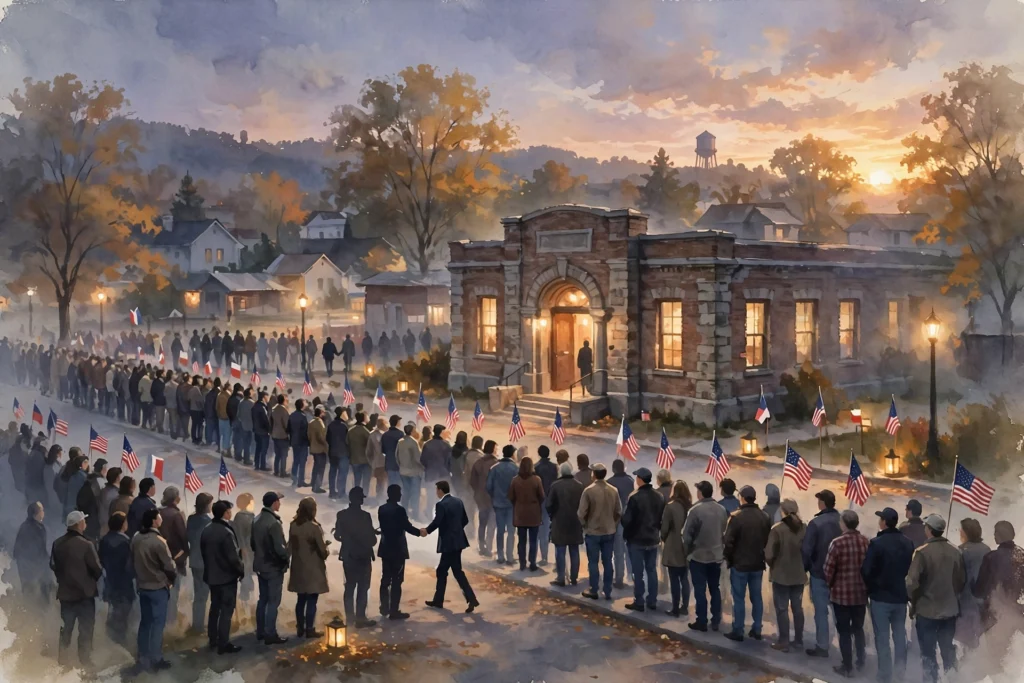
Colom, a 43-year-old district attorney from northern Mississippi, had turned up at the rally site hours before Trump arrived. He held a news conference in Corinth criticising Senator Cindy Hyde-Smith for refusing to debate him, then walked the line of supporters waiting at the gates, shaking hands, introducing himself and asking people what worried them. The Associated Press had reported before the event that Colom planned to do exactly that, and the gamble worked: his walk drew national media attention and pulled the spotlight away from the president’s visit to a state Republicans had expected to win without trouble.
The Corinth Trump Rally: A Line, a Handshake and an Insult
The rally took place on October 26 at the Crossroads Arena in Corinth, about a week before the November 3 election, where Trump had travelled to campaign for Hyde-Smith. By the time he took the stage, Colom had already spent hours outside talking to the people queuing to get in. Inside, the president mispronounced Colom’s name and attacked him as too liberal for the state. Trump spoke for more than 80 minutes, and when he called Hyde-Smith to the stage she needed only nine words in six seconds, asking the audience, “Is this not the best president in our lifetime?”
What the audience inside did not see was the challenger working the line outside, the part Trump ended up admiring. Colom’s approach that day matched his strategy all campaign: criticise the president’s policies, especially the Iran war that he said had driven up gas prices and the tariffs he said were hurting Mississippi farmers, without personal jabs at the president or his voters. He aimed his fire at Hyde-Smith, whom he portrayed as a nonentity in Washington, while promising to look out for people in his state. The line outside the arena was that approach in its purest form, a Democrat making his case to the other side’s voters face to face.
From “Shameless Phony” to “A Lot of Credit”
The distance between Trump’s two verdicts on Colom measures how much changed in Mississippi between late October and mid-November. At the rally, Colom was the target, a Democrat the president mocked to warm up a friendly crowd. On Thursday, in a White House interview for Smith’s podcast, Trump treated him as a worthy opponent, a campaigner who had shown what the president called chutzpah by turning up where he was least welcome and making his pitch anyway. It was a rare example of the Republican president showing admiration for a Democrat, and it landed the day after the Associated Press had called the race in Colom’s favour.
The praise also carried an edge of self-interest Trump did not hide. He spoke proudly of his own crowd and framed Colom’s effort as a tribute to the draw of his rally as much as to the candidate’s nerve, letting him compliment a Democrat without conceding anything about the result. Still, a president who rarely gives ground to his opponents had singled out the man who beat his chosen candidate and said he deserved credit for how he did it.
How Colom Won Mississippi in the 2026 Midterms
The Associated Press called the tight race in Colom’s favour on Wednesday, after local officials spent several days processing absentee and provisional ballots, called affidavit ballots in Mississippi. Officials estimated 12,000 to 20,000 such ballots were cast, and the count stretched for more than a week after Election Day. When the call came, the Associated Press put Colom ahead by 4,669 votes, about half a percentage point, out of 962,237 ballots counted. Hyde-Smith conceded on Wednesday evening in a short statement posted online, saying she wanted to congratulate Colom and wish him well as he took on the tremendous responsibility of representing the state.
Colom built the upset around the issues voters said mattered most: the cost of living, government accountability and rural opportunity. His campaign covered all 82 counties, speaking to Black voters, about 35 percent of the electorate, and to white working-class voters feeling the pinch of rising grocery and fuel prices. One widely shared campaign advertisement seized on Hyde-Smith’s suggestion that shoppers facing high beef prices could simply choose other proteins. Election polls in the final weeks had suggested a close contest, but few analysts expected the Democrat to finish ahead in a state Trump had carried by nearly 23 points just two years earlier.
The campaign also carried a personal edge. Hyde-Smith had blocked Colom’s nomination for a federal judgeship, history the campaign used to frame the race as a contest between an incumbent protecting the old order and a challenger denied a seat at the table once before. Former Vice President Kamala Harris headlined a rally for Colom in Columbus on October 22, and former President Bill Clinton campaigned for him in the final days. Colom, who has served as district attorney for Mississippi’s 16th Judicial District since 2016, presented himself throughout as a prosecutor who would hold power to account.
A Historic First for Mississippi
The victory broke a drought that stretched back 44 years. The last Democrat to win a Senate race in Mississippi was John Stennis, who won his final term in 1982 after first being elected in 1947. Colom will also become the state’s first Black senator since the Reconstruction era, and the first elected by popular vote in Mississippi: the two Black men who represented the state in the 1870s, Hiram Rhodes Revels and Blanche Bruce, were chosen by the state legislature rather than by voters. In a state where Black residents make up the highest share of the population of any state, Democrats celebrated the result as a breakthrough and a possible sign that the politics of the South are shifting.
Colom is a seventh-generation Mississippian, born in Columbus on December 24, 1982; his mother, Dorothy Colom, was the first Black person elected to a chancery court judgeship in their district. He became the first Black district attorney of the 16th Circuit and the first Black elected district attorney of a majority-white district in the state. In 2022, President Joe Biden nominated him to be a federal district judge, the nomination Hyde-Smith later blocked. On Wednesday night, about a thousand supporters gathered at Tougaloo College in Jackson to celebrate.
Former Presidents Bill Clinton and Barack Obama congratulated Colom, and Senate Democratic leader Chuck Schumer declared that blue Mississippi had arrived. Party leaders across the South called the result evidence that Democrats could win in states written off as unwinnable, and observers in both parties described it as a seismic shift in a state long controlled by white conservatives.
The 2026 Midterms and the Battle for the Senate
The Mississippi victory gave Democrats their eighth flipped Senate seat of the 2026 midterms, after Texas, Maine, Ohio, Iowa, North Carolina, South Carolina, Kansas. The result put Democrats at 55 seats, with one race, in Alaska, still to be determined. There, Democrat Mary Peltola was leading incumbent Republican Dan Sullivan, and if she holds on, Democrats would reach 56 seats, their biggest Senate majority in more than a decade.
The party flipped control of both chambers, routing Republicans across the country in an election widely read as a rebuke of the Trump administration. Mississippi, the deepest-red state on the list of flips, became the exclamation point on that story. The 120th Congress, convening in January, will include a record seven Black senators, a milestone reflecting both Colom’s victory and the broader results of this year’s elections.
Trump’s praise sits awkwardly against that backdrop. Having lost the seat, the Senate and the House, his response to the man who took the Mississippi seat was to compliment his campaigning, a graciousness he has rarely shown a victorious opponent. It may say as much about the Corinth line as about the result: the president respects a show of nerve, and Colom showed it in front of his own supporters.
What Happens Next: Certification and the Senate Races to Watch
Mississippi’s counties had until Friday to certify their results, and with no recount law in the state, the call and Hyde-Smith’s concession settled the contest. Colom will take his seat when the 120th Congress convenes in January, joining a Democratic majority that will set the agenda in both chambers. His first months will be shaped by the same issues that defined his campaign: the cost of living, government accountability and rural communities long overlooked in Washington.
The last piece of the 2026 Senate map is Alaska, the remaining senate race to watch, where the count is not finished and the final number will determine the size of the Democratic majority. Democrats have promised aggressive oversight of the Trump administration, and with the gavels in both chambers, the committees that oversee the executive branch will be in Democratic hands. Colom, a freshman senator from a state that had not sent a Democrat to Washington in 44 years, will be watched closely in a majority spanning the ideological spectrum.
Whether Trump’s praise amounts to more than admiration for a campaign tactic is an open question. Colom won by criticising the president’s policies while refusing to attack the president’s voters, and Trump praised the courage of that approach while saying nothing about the policies themselves. The two men will now work in the same capital, one as president and the other as a senator from a state the president carried easily two years ago. The Corinth line is behind them. What matters now is whether the respect Trump showed for Colom’s nerve survives the politics that divided them.
Source: The Associated Press