Pope Leo Peru Homecoming Draws Record 3 Million Crowd
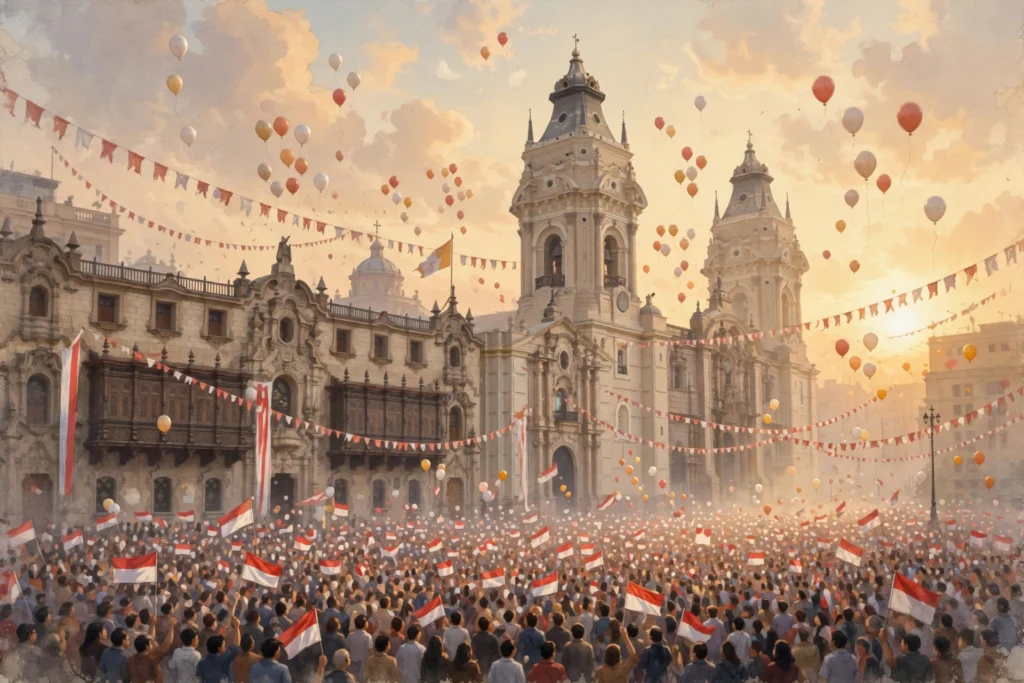
The world news out of South America this week belongs to a homecoming. Pope Leo XIV was greeted by the largest crowd of his papacy in an emotional return to Peru on Wednesday, declaring the South American country where he served as a missionary for two decades his homeland. The huge crowds, estimated at three million by local officials, pressed against police and security barriers in Lima, waving balloons and flags and chanting his name as he toured the capital in an open-air popemobile and waved energetically to the faithful. For a pontiff born in Chicago who spent twenty years of his life in Peru, the welcome was not a state visit in the ordinary sense. It was a return to the place that shaped him.
The pope’s arrival in Callao, the port city beside Lima, set the tone for the whole visit. People waving flags and wearing pope-themed shirts filled the main plaza in Lima and erupted into loud cheers as a big screen showed the plane touching down. Some held signs that read “Welcome home.” Crowds lined the streets of the capital for miles to welcome Leo, evoking images of previous papal trips to Catholic strongholds like the Philippines, Mexico and Brazil. A Vatican statement, citing local officials, said that three million people greeted Leo on his arrival in Lima, setting another record for the biggest crowd of his papacy after an estimated 2.5 million people attended an outdoor Mass he celebrated in Buenos Aires earlier this week.
The scale of the welcome matters because of what it says about the man at the centre of it. Leo, originally from Chicago, is visiting Peru on the final and most personal stop of the most intense overseas trip by a pope in decades, after touring Uruguay and Argentina. The six-day visit is expected to include poignant scenes as the pope sees old friends and spends three days in the northern city of Chiclayo, where he was bishop from 2015 to 2023. Peru prepared for the homecoming by erecting a 14-metre statue depicting Leo with outstretched arms, towering over a seaside park in Callao, while merchants in Lima sold pope-themed shirts and souvenirs to the faithful who had come to see him.
World News: A Record Crowd in Lima
The numbers behind the visit tell a story of a papacy drawing extraordinary crowds across South America. The Vatican statement said three million people greeted Leo in Lima, a figure that set another record for the biggest crowd of his papacy. The previous record had been set only days earlier, when an estimated 2.5 million people attended an outdoor Mass he celebrated in Buenos Aires. He ended the Argentina leg of his South American tour earlier on November 11 with another outdoor Mass that drew a crowd of two million outside the shrine of Our Lady of Lujan. Three record crowds in a single week, across two countries, is a measure of the enthusiasm this 12-day trip has generated.
The scenes in Lima matched the scale of the numbers. The huge crowds pressed against police and security barriers, waving balloons and flags and chanting “Leo, Leo, Leo” as the pope passed. The faithful gathered around a statue of Jesus Christ as they waited for his arrival, and the streets of the capital were lined for miles with people hoping for a glimpse of the popemobile. For Peru, a country where the Catholic faith runs deep, the return of a pope who is also a Peruvian citizen carried a meaning no ordinary visit could match.
The visit is the final leg of a three-nation Latin American tour, and it comes just weeks after the pope underwent surgery for lung cancer. Leo began the trip less than a month after the operation and has appeared in good form, making long speeches in a firm, clear voice. The 71-year-old travelled to Uruguay and Argentina before heading to Peru, and the pace of the journey has been demanding by any standard. That he has drawn the largest crowds of his papacy while still recovering from surgery has only added to the sense of occasion surrounding the trip, and to the attention being paid to every appearance he makes.
Pope Leo’s Two Decades in Peru
To understand why the homecoming matters so much, it helps to know how much of Leo’s life belongs to Peru. The pope was born in Chicago, in the United States, but served in Peru as a missionary priest and bishop for two decades and obtained citizenship there, before being tapped to lead the world’s 1.4 billion Catholics. Robert Prevost, as he was then known, arrived in Peru as a young Augustinian missionary and stayed, learning the country from the inside over twenty years of pastoral work. He was Bishop of Chiclayo, in the north of the country, from September 26, 2015, to 2023, and the city remains the centre of his Peruvian life.
Peruvians remember him not as a distant churchman but as a priest who was present in their hardest moments. Riding on horseback to visit the most isolated Andean areas of his community, distributing food amid the Covid-19 pandemic, and wearing rubber boots in the water and mud of floods: this is how many Peruvians remember the man who is now Pope Leo XIV. Peru recorded more than 219,000 deaths during the pandemic, according to Johns Hopkins University figures, one of the highest coronavirus mortality rates in the world, and the memory of priests who stayed through that period runs deep. The country also received more than 1.6 million Venezuelans through November 2025, the second-highest number in the region after Colombia, and the Church’s work with migrants is part of the same story of a pastor close to his people.
The personal character of the visit is visible in its details. The pope will receive a new Peruvian identity card that lists Chiclayo as his address, a small administrative fact that carries a large symbolic weight. His itinerary takes him back to the places and the people who knew him as Father Robert and then as Bishop Robert, before the world knew him as Leo XIV. For the faithful who waited in Lima, the visit is a chance to welcome home a man they watched become a priest, a bishop and then a pope, and for the pope himself, the return holds what he described as a very special meaning.
A Speech to President Keiko Fujimori
The most closely watched moment of the first day came shortly after the pope was greeted in Lima, when he addressed President Keiko Fujimori and the country’s political leaders. In a speech at Lima’s Gran Teatro Nacional, Leo said his return to Peru held a very special meaning. “Today I understand how much of this land remains with me and how much of my own story also belongs to you,” he said. “I can tell you, with deep gratitude, that I am returning to my homeland.” The words drew an emotional response from the audience, and they set the tone for a visit that is as much about Peru’s national story as about the pope’s personal one.
The speech also carried a political message. In a closely watched address to Fujimori, whose father Alberto Fujimori led Peru through the turbulent 1990s and a brutal war against Maoist Shining Path rebels, Pope Leo urged the president to build confidence among her people after her narrow election victory earlier in 2026, and alluded to the contested legacy of her father. He invited Fujimori to confront the wounds of the country’s turbulent past. “Past events deserve to be treated with justice and sensitivity, leaving room for harmony to grow and for differences to be addressed with respect,” he said. The pontiff also called on Peruvians to cultivate “honesty, integrity, and a willingness to engage with others”, saying those qualities were essential to sustaining trust and democratic institutions.
Fujimori, in welcoming the pope, said his visit was an invitation for Peru to pursue its “unfinished task” of national reconciliation. The exchange carried a history of its own. When Alberto Fujimori was pardoned in 2017, Leo, then Bishop Robert Prevost, criticised the move, saying the former president should personally seek forgiveness from victims if Peru were to achieve genuine reconciliation. The pope’s return to Lima, and his decision to raise the question of the past directly with the daughter of the man he once criticised, gave the speech a weight that went beyond ceremony.
A Trip Weeks After Lung Cancer Surgery
The physical demands of the journey have been part of the story from the start. Pope Leo began the trip less than a month after lung cancer surgery, and the 12-day itinerary across three countries is the most intense overseas trip by a pope in decades. He has appeared in good form throughout, making long speeches in a firm, clear voice, and the crowds have responded with an enthusiasm that has surprised even seasoned Vatican watchers. The combination of a recent operation and record crowds has made the tour one of the most closely followed papal journeys in years.
The Argentina leg set the pattern. An outdoor Mass in Buenos Aires drew an estimated 2.5 million people, and the closing Mass of that leg, outside the shrine of Our Lady of Lujan, drew two million more. President Milei welcomed the pope during the historic visit to Argentina, and Leo met with clergy abuse survivors and told Argentina’s leaders that they should know the limits of power. Each stop has added to the sense that this is a pontificate defining itself on the road, in front of crowds that are turning out in numbers not seen for a visiting pope in many years. For Peruvians, the fact that he came so soon after surgery, to the country where he spent twenty years of his life, has only deepened the welcome. The visit is being read in Lima not as a routine stop on a papal tour, but as a deliberate choice by a pope who wanted to come home.
What Happens Next: Chiclayo, Cusco and a Closing Mass
The six-day visit, scheduled for November 11 to 16, still has its most personal chapters ahead. The pope is scheduled to spend three days in Chiclayo, the northern city where he was bishop from 2015 to 2023, and where old friends, former parishioners and the priests he ordained are waiting to see him. The itinerary also includes Cusco and Pucallpa, as well as Santa Cruz de Succhabamba in the northern Andes, taking him back to the rural communities he once visited on horseback. The main aircraft for the journey will be an Mi-17 helicopter belonging to the Peruvian Air Force, supported by three other helicopters of the same model, each capable of carrying up to 24 people, a detail that has earned the aircraft the nickname of the “papacopter” in local coverage.
The visit will close with a Mass in Lima that organisers expect to be one of the largest gatherings of the whole trip. The closing Mass is scheduled for November 16 at Las Palmas Air Base in the Surco district, and organisers anticipate up to 1.2 million people. Admission will be free, but access will require a digital ticket obtained in advance, and registration through Ticketmaster opened from November 5 to 8. The organisers have stressed that tickets are personal and non-transferable. The air base will open at 10:00 p.m. on November 15, twelve and a half hours before the Mass begins at 10:30 a.m. the following day, in an effort to prevent congestion among the crowds expected to arrive through the night.
Source: Reuters