US News Today: SS United States Sinks as Gulf Reef
The us news today includes the final voyage of one of the most famous ships in American history. The SS United States, the largest passenger ship ever built in America and the fastest ocean liner ever to cross the Atlantic, was deliberately sunk in the Gulf of Mexico on Wednesday, beginning its new life as what officials say will be the world's largest artificial reef.
The sinking, which had been planned for Thursday, was moved up a day because of forecast heavy winds and unsafe marine conditions, and the operation began at about 1 p.m. Central time, roughly 22 nautical miles southwest of Destin, Florida. Crews opened valves connected to the vessel's original seawater intake pipes and began flooding the ship, a process expected to take about 45 minutes but one that unfolded so slowly that most of the 990-foot hull was still above the surface as the sun set on the idle ship, surrounded by the blinking lights of nearby vessels.
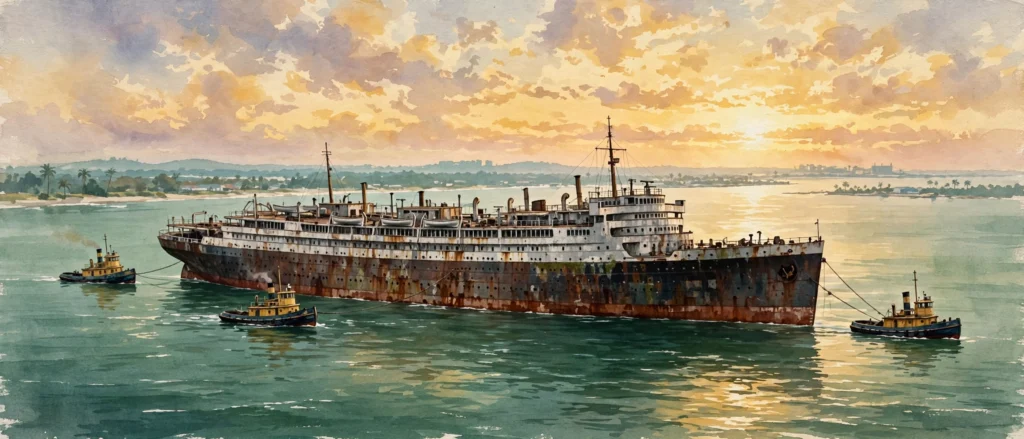
The finale was presented in a livestream that showed aerial views of the once-grand vessel's rusted hull, stripped of its two smokestacks, afloat but quietly and slowly settling into the calm waters of the Gulf. The ship was surrounded by onlookers and safety crews aboard dozens of tugboats and recreational vessels that had accompanied the ocean liner as it was towed out to sea for its final voyage, and crowds gathered at public watch parties on shore to see the old liner off.
A Slow Final Descent
The sinking did not look like the dramatic plunge that the word suggests. There were no explosives and no sudden rush of water. Instead, the ship settled gradually, almost imperceptibly, as the controlled flooding filled its compartments, and for hours after the operation began, the great hull remained largely visible above the waterline, a rusted silhouette against the evening sky.
Okaloosa County officials had planned the operation carefully. The sinking was originally scheduled for Thursday, November 12, but the county moved it up a day because of the weather forecast, which called for heavy winds and unsafe marine conditions that could have complicated the delicate work of settling a 990-foot ship onto the seabed. The decision meant cancelling a scheduled public sendoff ceremony, but it also meant the operation could proceed in calm water.
Public viewing began at noon on Wednesday, with free watch parties at Seville Quarter in downtown Pensacola and at AJ's Seafood and Oyster Bar in Destin. The sinking was livestreamed through the project's website and through local news outlets, so that people who could not be on the water could still watch the final hours of a ship that had been part of American life for three quarters of a century.
The ship had reached its designated reef location after being towed from Mobile, Alabama, where it departed on Monday. The tow brought the vessel to a spot about 22 nautical miles southwest of Destin-Fort Walton Beach and 32 nautical miles southeast of Pensacola Pass, at coordinates released by Okaloosa County, where it will now rest on the gulf floor.
How a 990-Foot Ship Is Sunk on Purpose
Sinking a ship the size of the SS United States on purpose is a careful engineering operation, and the method chosen was controlled flooding rather than explosives. Crews began by opening valves connected to the vessel's original seawater intake pipes at about 1 p.m., allowing the Gulf to flow in through the ship's own systems, and they had cut holes strategically throughout the hull and the decks to ensure that the vessel would sink in a gradual, level, and uniform manner.
The goal was for the ship to come to rest upright on the seabed, not tipped on its side or broken apart. If all goes as planned, the aging liner will settle at a depth of about 180 feet off the coast of Destin, a resort town and recreational fishing haven known for its white sand beaches and emerald green waters, with its upper deck ending up about 50 feet beneath the surface.
That depth matters. At 180 feet, with the top of the wreck within reach of experienced divers, the ship will be accessible to the diving community that Okaloosa County hopes to attract, while remaining deep enough to serve as a stable reef. The county bills the project as the world's largest artificial reef, a claim that rests on the sheer size of the vessel: at nearly 1,000 feet from stem to stern, the SS United States dwarfs the ships that have been sunk as reefs before it.
The operation was the finale to a year-long process of preparing the ship for disposal at sea, a process that included extensive environmental remediation to remove hazardous materials and to make the vessel safe to sink. The ship was towed to a shipyard in Mobile, Alabama, where that work was carried out, after Okaloosa County obtained permission from the US Coast Guard and other agencies.
From Speed Record to Scrap Threat
The SS United States was a marvel of postwar American engineering, and its story begins 75 years ago, when it was first launched at sea. On its maiden voyages in the early 1950s, the liner set a transatlantic speed record that it still holds, crossing the Atlantic faster than any liner before it, in either direction, and becoming a symbol of American speed, luxury, and industrial might.
The ship carried the rich and famous across the Atlantic at speeds still unmatched, a floating palace of mid-century America, and for a time it was the pride of the country's merchant fleet. But the rise of commercial air travel changed the economics of ocean travel, and the liner was retired from service in 1969, after less than two decades of carrying passengers.
What followed was a long, slow decline. The vessel sat moored for nearly 30 years in Philadelphia, seemingly destined to be sold for scrap, its paint peeling and its interiors stripped, a ghost of its former glory tied up at a pier while the city changed around it. Preservationists fought to save it, and over the years there were plans to restore it, to turn it into a hotel or a museum, but none of them found the money, and the ship's future looked increasingly like the scrapyard.
The rescue came from an unexpected direction. Authorities in Okaloosa County, in Florida's panhandle, stepped in to purchase the ship as part of a project costing about $13 million, with a plan that no preservationist had imagined: to sink the great liner on purpose, and to turn it into a reef. The county bought the retired ocean liner in 2024, and the plan that followed was to give the ship a second life underwater, as a home for marine life and a destination for divers.
The Fight to Save Her
Not everyone agreed that sinking was the right end for the ship. The SS United States Preservation Foundation, a group that had campaigned for years to save the liner, filed a federal lawsuit seeking to prevent the towing and sinking, arguing that the historic vessel deserved a future above the waterline. A judge denied the group's motion on November 6, clearing the way for the final voyage to proceed.
The legal fight was the last chapter in a decades-long argument about what the ship was worth and what should happen to it. For preservationists, the SS United States was a national treasure, the fastest ocean liner ever built and a symbol of an era when American ships ruled the Atlantic. For Okaloosa County, it was a chance to create something new from something old, a reef that would draw divers and fishermen to the Florida panhandle for generations.
The county's plan won out, and the preparations began. The ship was towed from Philadelphia to Mobile, where workers spent months removing hazardous materials, cutting the holes that would control the flooding, and preparing the hull for its descent. The work was extensive, and it was the reason the sinking took a year to arrange after the purchase.
The move to sink the ship a day early, on Wednesday instead of Thursday, was a reminder of how much of the operation depended on the weather. Heavy winds and unsafe marine conditions were forecast for Thursday, and the county's public information officer said the change was made to keep the operation safe, even though it meant cancelling the public sendoff ceremony that had been planned.
What the Reef Means for Destin
The new reef will be in good company. The SS United States will join a collection of more than 500 smaller underwater sites created from the remains of various sunken ships, a divers' haven known as the Destin-Fort Walton Beach Artificial Reefs. But none of those sites is anything like the size of the liner, and the county expects the new reef to become the centerpiece of the system.
For Destin, a resort town built on fishing and diving, the reef is an investment in the future. Artificial reefs attract marine life, and marine life attracts divers and fishermen, who in turn support the hotels, restaurants, and charter boats that make up the local economy. A 990-foot wreck, sitting upright in 180 feet of water with its upper deck about 50 feet down, is a destination that divers will travel to see, and the county is counting on that.
The reef will also serve a purpose beyond tourism. Artificial reefs provide habitat for fish and other marine life, creating ecosystems where there was only open sand before, and the SS United States, with its vast interior spaces and complex structure, will offer shelter and breeding grounds for a wide range of species. Over time, the bare steel of the hull will be colonized by coral, sponges, and other organisms, and the ship will become, in the most literal sense, a living reef.
The project is one of the largest of its kind ever attempted, and its success will be watched by other coastal communities that have considered sinking large ships as reefs. If the SS United States settles upright and holds its position, it will stand as proof that even a vessel of this size can be reefed safely, and it may open the way for other decommissioned ships to follow.
What Happens Next
The sinking itself is only the beginning. In the hours and days after the operation, crews will monitor the ship to confirm that it has settled upright on the seabed and in the position that was planned, and the coordinates released by the county may change slightly once the vessel has come to rest. The upper deck, expected to end up about 50 feet beneath the surface, will be the first part of the wreck that divers can reach.
Over the coming months, the reef will begin to change. Marine life will move in quickly, and the county and local diving operators will watch the colonization of the wreck with interest, tracking which species arrive first and how the ecosystem develops. The site is expected to open to divers once officials are satisfied that it is stable and safe, though no date has been set for that yet.
For the people who watched the ship go down on Wednesday, whether from the shore at Destin or Pensacola or on the livestream, the sinking was the end of an era and the start of another. The SS United States spent 75 years above the water, most of them as a memory and a rusting hulk, and it will now spend its next decades below it, as a reef, a dive site, and a piece of American history resting on the floor of the Gulf of Mexico.
The ship that once raced across the Atlantic faster than any liner before it has made its final voyage, and it did so slowly, quietly, and on its own terms, settling into the calm waters off Florida as the sun set and the lights of the watching boats blinked around it. The record it set in 1952 still stands. The reef it has become is now the largest of its kind in the world.
Source: Reuters