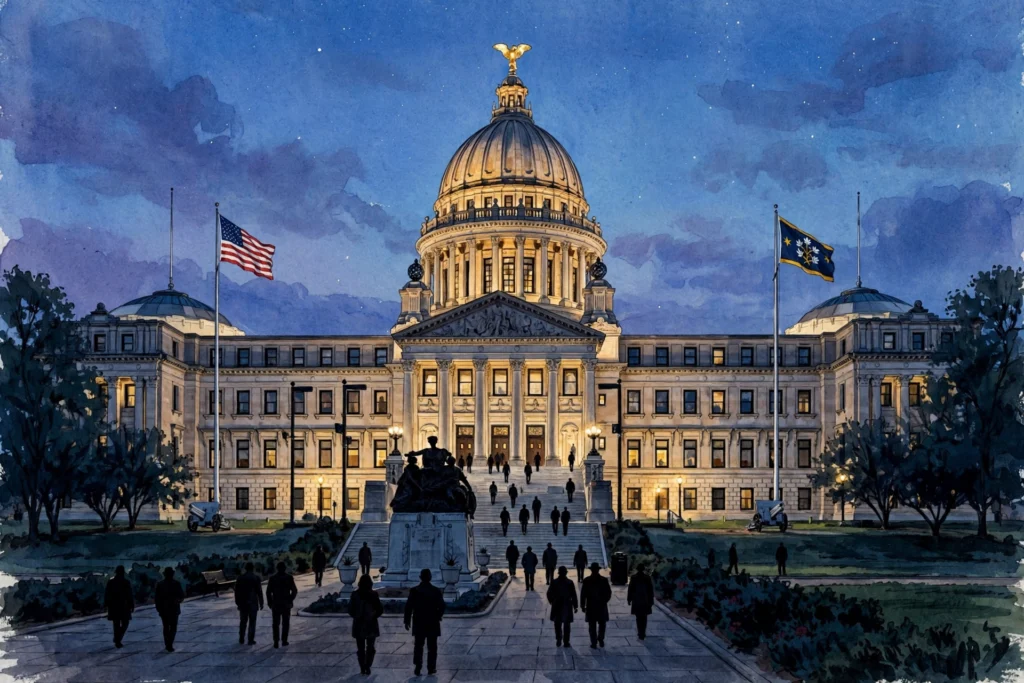
Midterm Elections 2026: Colom’s Historic Mississippi Win
The midterm elections 2026 delivered their biggest shock on Wednesday night, when Democrat Scott Colom defeated Republican Senator Cindy Hyde-Smith in Mississippi, a state where no Democrat had won a Senate race in more than four decades. The Associated Press called the contest for Colom after days of counting absentee and provisional ballots, and Hyde-Smith conceded on Wednesday evening, closing one of the closest and most closely watched Senate races of the entire midterm cycle.
Colom, a 43-year-old district attorney from eastern Mississippi, led Hyde-Smith by more than 4,500 votes, a margin of about half a percentage point, with more than 95 percent of ballots counted. The final tally showed Colom with 49.2 percent of the vote against 48.7 percent for the incumbent, a result that stunned political observers in both parties and immediately reshaped the story of a midterm election that had already gone badly for Republicans.
The victory was historic on several fronts at once. Colom became the first Democrat elected to the United States Senate from Mississippi since 1982, and the first Black Mississippian elected to the Senate since the Reconstruction era that followed the Civil War. In a state where Black residents make up nearly 40 percent of the population, the highest share of any state in the country, the result was celebrated by Democrats as both a breakthrough and a sign that the political map of the South may be shifting.
A Week of Counting Ends in an Upset
The race was not decided on election night. When voters went to the polls on November 3, the contest was too close to call, and local election officials spent the days that followed processing absentee and provisional ballots, known in Mississippi as affidavit ballots. The count stretched on for more than a week, with the lead changing hands in the public imagination even as the actual margin stayed narrow, and national attention fixed on a state that few analysts had expected to be competitive at all.
The Associated Press finally called the race on Wednesday, after the remaining ballots had been counted and Colom's lead had held. The call came more than a week after Election Day, making the Mississippi contest one of the last Senate races of the 2026 midterms to be decided, alongside the still-undecided race in Alaska. Colom scheduled a victory celebration with supporters for Wednesday night in Jackson, the state capital, where the campaign had been based.
Hyde-Smith conceded the race on Wednesday evening, according to Colom's campaign, bringing an end to a contest that had drawn millions of dollars in outside spending and wall-to-wall national coverage in its final days. The incumbent had served in the Senate since 2018 and had won her 2020 race by a comfortable ten-point margin, which made the narrow defeat all the more surprising to the Republican establishment that had assumed the seat was safe.
The closeness of the result was itself part of the story. The two candidates were separated by fewer than 5,000 votes out of more than a million cast, and the race remained within half a point from the first returns to the final count. It was, by any measure, one of the tightest Senate races in the country this year, and one of the biggest upsets of the 2026 midterms.
A Historic First for Mississippi
Colom's victory broke a drought that stretched back 44 years. The last Democrat to win a Senate race in Mississippi was John Stennis, who won his final term in 1982. Stennis had first been elected to the Senate in 1947 and served for more than four decades, and his 1982 victory over a young Republican challenger named Haley Barbour, who later became governor, was the last time Mississippi voters sent a Democrat to the Senate.
The racial history of the result runs even deeper. Colom will be the first Black senator from Mississippi since Blanche Bruce, a formerly enslaved man who was elected to the Senate in 1874, during Reconstruction. He is also the first Black person elected statewide in Mississippi since that era, in a state whose politics have been dominated for generations by white conservatives despite having the largest share of Black residents of any state in America.
The change will be visible in the Senate itself. The 120th Congress, which convenes in January, will include a record seven Black senators, a milestone that reflects both Colom's victory and the broader results of this year's elections. For a chamber that has seated only a handful of Black members in its entire history, the number marks a genuine shift in who represents the country in Washington.
The result also reflected the geography of Mississippi politics. Turnout was strong in the Mississippi Delta and its concentration of majority-Black counties, where Colom ran up the margins he needed, but the shift was not confined to one region. Nearly all of the state moved leftward compared with the 2024 election, when President Donald Trump carried Mississippi by nearly 23 points, suggesting that the result was driven by more than turnout in a single part of the state.
How Colom Built the Upset
Colom built his campaign around the issues that voters in Mississippi told pollsters mattered most to them: the cost of living, government accountability, and expanding opportunity in rural communities. A longtime district attorney for Mississippi's 16th Judicial District, he presented himself as a prosecutor who would hold power to account, and he drew support from national Democratic figures, including former President Bill Clinton, who campaigned for him in the race's final days.
The campaign also carried a personal edge. Hyde-Smith had previously blocked Colom's nomination for a federal judgeship, a piece of history between the two candidates that the Colom campaign used to frame the race as a contest between an incumbent protecting the old order and a challenger who had already been denied a seat at the table once before. The contest attracted national attention as outside groups and party organizations poured millions of dollars into Mississippi, turning what had once been considered a long-shot Democratic bid into one of the nation's most closely watched Senate contests.
Hyde-Smith, 67, had sought a second full term after joining the Senate in 2018. She had the advantages of incumbency, name recognition, and a state that had voted Republican in every Senate race for more than four decades, but she also carried the weight of a difficult national environment for her party. The midterm elections on November 3 delivered a drubbing to Republicans across the country, and Mississippi, for all its Republican history, was not immune.
The election polls that tracked the race in its final weeks had suggested a close contest, but few expected the Democrat to finish ahead. That Colom did so, in a state Trump had carried by nearly 23 points just two years earlier, is why national political observers described the result as one of the biggest surprises of the 2026 midterms, and why the discussion it set off went far beyond Mississippi's borders.
What the Result Means for the Battle for the Senate
The Mississippi victory gave Democrats their eighth flipped Senate seat of the 2026 midterms. The party had already flipped seats in Texas, Maine, Ohio, Iowa, North Carolina, South Carolina, and Kansas, and Colom's win added Mississippi to a list that spanned the country and included some of the most Republican states on the map. The result put Democrats at 55 seats in the 100-member Senate, with the winner in one remaining race, in Alaska, still to be determined.
In Alaska, Democratic candidate Mary Peltola was leading incumbent Republican Dan Sullivan in the only other Senate race still awaiting a result. If Peltola holds on, Democrats would reach 56 seats, their biggest Senate majority in more than a decade, a margin that would give the party real room to maneuver when the new Congress convenes in January.
The scale of the Democratic gains was the story of the night on November 3 and has only grown since. The party flipped control of both the House and the Senate, routing Republicans across the country in an election that was widely read as a rebuke of the Trump administration. Mississippi, the deepest-red state on the list of flips, became the exclamation point on that story, the result that turned a strong Democratic night into a historic one.
For the battle for the Senate, the implications are practical as well as symbolic. A 55-seat majority, and possibly 56, gives Democrats a cushion on confirmations, on legislation, and on the oversight investigations that the incoming majority has promised. It also means that the party's path to holding the Senate in future cycles runs through states that, until this week, few strategists would have put on the map.
Reactions Across the Country
Reaction to Colom's victory came quickly from the top of the Democratic Party. Senate Democratic leader Chuck Schumer celebrated the outcome with the declaration that blue Mississippi had arrived, a line that captured the disbelief and delight of a party that had not won a Senate race in the state in living memory for most of its members. Former President Bill Clinton, who had campaigned for Colom in the final days, celebrated the result on social media, and prominent Democratic leaders across the country framed the win as both a historic breakthrough in Mississippi and one of the most significant victories of the 2026 midterm elections.
Kentucky Governor Andy Beshear, a Democrat and a possible contender for the party's presidential nomination in 2028, hailed Colom's victory as history-making, and party leaders across the South pointed to the result as evidence that the region's politics are changing. The outcome, they argued, showed that Democrats could compete and win in states written off as unwinnable, and it immediately fueled discussion about whether the result could signal broader shifts in Southern politics.
The reaction was not confined to Democrats. National political observers in both parties described the result as a seismic shift in a state controlled mostly by white conservatives for generations, and noted that the upset added to a decisive midterm rebuke of the president, whose party had suffered defeats in several Republican-controlled states. The fact that the victory came in Mississippi, of all places, made it the result that analysts kept returning to as they tried to explain what had happened on November 3.
What Happens Next
Colom will take his seat when the 120th Congress convenes in January, joining a Democratic majority that will set the agenda in both chambers for the first time in years. His first months in office will be shaped by the same issues that defined his campaign: the cost of living, government accountability, and the needs of rural communities that have long felt overlooked in Washington.
The new majority's priorities are already taking shape. Democrats have promised aggressive oversight of the Trump administration, and with the gavels in both chambers, the committees that oversee the executive branch will be in Democratic hands. Colom, as a freshman senator from a state that had not sent a Democrat to Washington in 44 years, will be watched closely for how he navigates a chamber where his party's majority is real but its members span the ideological spectrum.
The Alaska race remains the last piece of the 2026 Senate map. With Peltola leading, Democrats are on course for 56 seats, but the count there is not finished, and the final number will determine just how large the party's majority will be. Whatever the outcome in Alaska, the shape of the next Senate is now clear, and Mississippi, improbably, is part of the reason why.
For Mississippi itself, the result opens a new chapter. A state that had not elected a Democratic senator since 1982 and had not elected a Black senator since 1874 will now be represented in Washington by a 43-year-old prosecutor who built his campaign on the argument that the state's future runs through its people, not its past. The celebration in Jackson on Wednesday night was the beginning of that chapter, and the rest of the country will be watching to see how it unfolds.
Source: Associated Press