Trump News: Kennedys Sue to Block Arch Over JFK Grave
The latest trump news from Washington carries a family name that has not been heard in a federal courtroom in this fight until now. Nine members of the Kennedy family filed papers on Tuesday asking a federal judge to block President Donald Trump's planned 250-foot triumphal arch. They argue that the monument would cast a shadow over the graves of their relatives at Arlington National Cemetery and destroy the view from the eternal flame at President John F. Kennedy's gravesite. The filing turns a legal battle that began with three Vietnam veterans into a confrontation between the president and one of the most famous political families in American history.
The Kennedys are not starting a new case. They filed a motion to intervene in the lawsuit already before Judge Tanya Chutkan of the United States District Court for the District of Columbia. It is the same case in which she halted work on the arch last Thursday, within an hour of a federal planning commission approving it. Their complaint asks the court to set aside the government's authorization for the project and to block construction altogether. The White House did not immediately respond to a request for comment, but the administration has insisted the arch is lawful, arguing that Congress approved a monument at the site more than a century ago. The case also places the Kennedy name opposite a cabinet in which Robert F. Kennedy Jr., the late president's nephew, serves as health secretary.
Nine Kennedys, One Filing: Who Is Suing and Why
The nine plaintiffs are the children and grandchildren of the late President Kennedy's two brothers. Seven are children of Senator Robert F. Kennedy and Ethel Kennedy: Rory Kennedy, Maxwell Kennedy, Christopher G. Kennedy, Kerry Kennedy, Courtney Kennedy, Kathleen Kennedy Townsend, and Joseph P. Kennedy II. The other two are Joseph P. Kennedy III, a grandchild of Robert and Ethel Kennedy, and Edward M. Kennedy Jr., the son of Senator Edward M. Kennedy. The family members buried at Arlington include President Kennedy himself, First Lady Jacqueline Kennedy Onassis, Senator Robert F. Kennedy and his wife Ethel Kennedy, Senator Edward M. Kennedy, and Lieutenant Joseph P. Kennedy Jr.
The family is represented by Norman Eisen and Steve Jonas of the Democracy Defenders Fund. In a statement, the two lawyers called the arch "an illegal interference with Arlington National Cemetery and the heroes remembered there, including at the grave sites and memorials of the Kennedy brothers and Ethel Kennedy." They added: "Only Congress has the constitutional power to authorize an intrusion of this magnitude." The complaint names as defendants President Trump, White House Domestic Policy Council Director Vince Haley, the Executive Office of the President, Interior Secretary Doug Burgum, the Interior Department, and the National Park Service.
At the centre of the complaint is a single date: November 5, 2026. That is the day the National Park Service and the Interior Department authorized construction of the arch, according to the filing. The Kennedys say that authorization came without the congressional approval the law requires, that the defendants exceeded their legal authority, and that the approval was contrary to law and arbitrary and capricious. It points to the government's own findings of adverse effects, the large number of public comments opposing the project, and the planning commission's own finding that the arch would fully obstruct the reciprocal views between the Lincoln Memorial and Arlington. The filing also says the arch would block the view of the Kennedy gravesites and the eternal flame from Arlington Memorial Bridge, a sightline specially chosen by the Kennedy family.
The Shadow Over JFK's Grave
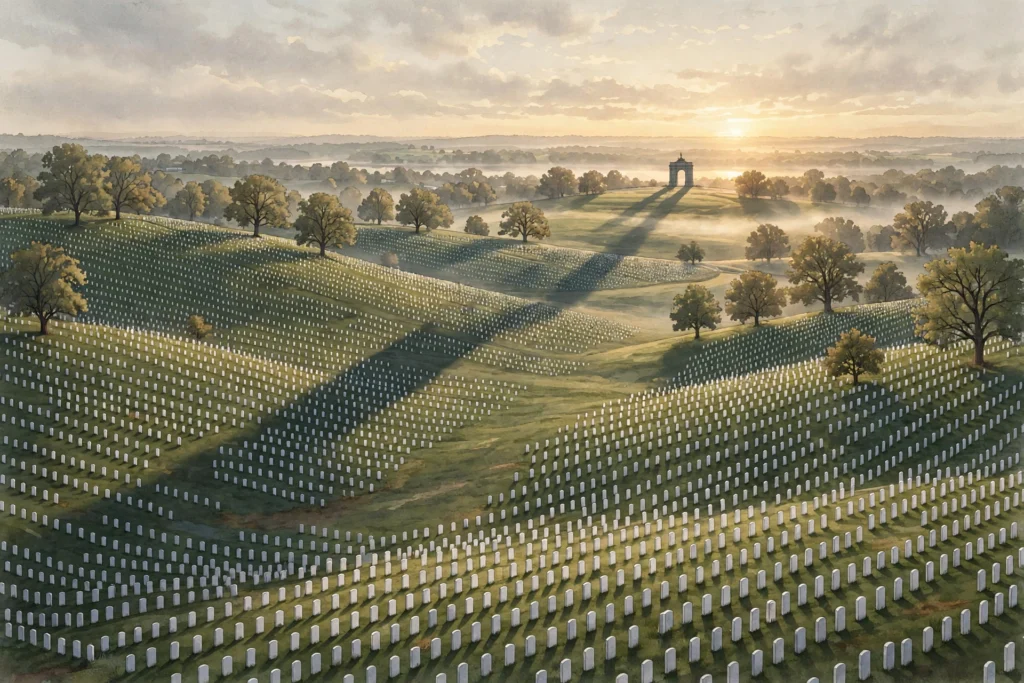
The shadow is not a metaphor. It is the most concrete and most contested fact in the dispute, and it has been measured twice, by two different teams, with results that point in the same direction even though the numbers differ. The Washington Post built a three-dimensional model of the arch to scale and tracked where its shadow would fall through the year. The newspaper found that the shadow would touch burial sites at Arlington on 284 days a year and would pass over more than 75,000 graves, including those of veterans of the Vietnam War, the Korean War, both World Wars, the Spanish-American War, and the Civil War.
The Post's analysis found that the shadow would briefly cover the eternal flame on 18 days a year and shade the Kennedy memorial on 50 days. On May 12, one of the days when the shadow would linger longest, it would cover the flame for nine minutes shortly after sunrise. One of the 18 days is July 28, the birthday of Jacqueline Kennedy, who chose the eternal flame after her husband's assassination. The shadow would also pass over the graves of Supreme Court Justices Thurgood Marshall, William H. Rehnquist, and Ruth Bader Ginsburg, and darken the Military Women's Memorial on 109 days. The design even calls for an eternal flame of its own atop the arch.
A separate study commissioned by VoteVets, a veterans advocacy group that opposes the project, reached a similar conclusion by a stricter method, counting a grave only if the arch blocked the entire disk of the rising sun over it on at least one morning. Even so, it found more than 50,000 mapped grave locations across 29 sections of the cemetery inside the shadow at some point in the year. At President Kennedy's grave and the eternal flame, the arch would block the full disk of the rising sun for about 29 minutes a year, spread across 17 dawns in mid-May and late July. The Interior Department has pushed back, calling the Post's analysis "as flawed as their leftist reporting." Retired Army Major General Paul Eaton, whose parents are buried at Arlington, called the prospect "a sacrilege."
A Judge Has Already Hit Pause
The Kennedy filing arrives in a case that has already produced a sharp judicial rebuke. On Thursday last week, the National Capital Planning Commission voted 8 to 4 to approve the project after a nine-hour hearing. During that hearing, 130 members of the public testified, more than 90 percent of them opposed, and about 1,000 people submitted written statements. Within an hour of the vote, Judge Chutkan blocked any work from starting. In a 33-page opinion, she said the arch required congressional approval and that its construction could prove costly to both Virginia and the District of Columbia while disrupting traffic at the cemetery. "The harm is certain," she wrote. Her temporary order blocks construction through November 19 while she considers a preliminary injunction.
The original lawsuit was filed on February 19 by veterans Michael Lemmon, Shaun Byrnes, and Jon Gundersen, joined by Calder Loth, a former senior architectural historian for Virginia. They argued that the building lacked the congressional approval required and would destroy the viewshed between Arlington House, across Memorial Bridge, and the Lincoln Memorial. That sightline was designed to symbolize the unification of the country following the Civil War. Lemmon, who served in the Army in Vietnam and later was the American ambassador to Armenia, testified that the arch would change the experience of visiting the cemetery in a "profound way." "The pain is real. … The idea of having a tourist platform 250 feet up in the air, looking over burials… I find it disruptive and disrespectful. This is hallowed ground," he said. The District of Columbia, Virginia, and Arlington County have all joined the suit.
What Trump Wants to Build at Memorial Circle
The structure at the centre of the case would stand 250 feet tall, about 76 metres, at Memorial Circle, on a highway roundabout near the entrance to Arlington National Cemetery and across the Potomac River from the Lincoln Memorial. It would be a granite-clad arch rising 12 stories, topped by statues including a 60-foot gold winged female figure holding a flame, flanked by gold flying eagles, with an observation deck overlooking the cemetery. It would be more than twice the height of the Lincoln Memorial on the other side of Memorial Bridge, and taller than the Arc de Triomphe in Paris, its inspiration.
The administration's account of what the arch is for has shifted over time. The National Park Service supported the project, citing a 1924 plan for the site that called for two 166-foot slender columns framing the vista between Arlington and the Lincoln Memorial. Commission chairman Mark Paoletta called the arch a "generational security opportunity," referring to an announcement last month that the facility would serve as a monument to the nation's 250th anniversary but also would host snipers and store drones and ammunition. Judge Chutkan questioned the timing of that announcement. "Ammunition and drones at a site that gets between 2,000 and 22,000 visitors a day [which also] stands in the path of aircraft? I think this is very serious," she said. VoteVets notes that when Trump was asked who the arch was for, he answered simply: "Me."
A Wider Fight Over the Capital's Monuments
The most direct parallel is the fight over the Kennedy Center for the Performing Arts, the concert hall Congress designated as a living memorial to President Kennedy. On December 18, 2025, Trump and his handpicked loyalists on the centre's board voted to rename it after him, and workers installed his name above Kennedy's on the exterior. Representative Joyce Beatty, a board member, sued, and a federal judge halted the renaming, noting that Congress had created the institution to honor Kennedy. An appeals court later ruled that Trump's name must stay off the facade while the appeal continues. The Kennedy family's new filing extends the same argument from a concert hall to a cemetery: a memorial Congress created for one president cannot be remade into a monument to another without Congress itself acting.
What Happens Next
The immediate question is whether Judge Chutkan will allow the Kennedys to join the case. A motion to intervene requires the court to find that the family has an interest the existing parties do not adequately represent. The filing argues that no one else in the case can speak for the effect on the Kennedy gravesites and the eternal flame. If she grants it, the Kennedys will press their own claims alongside the veterans and the governments of the District, Virginia, and Arlington County.
The larger question is the preliminary injunction. Her temporary order runs through November 19, and she must decide whether to extend the pause while the case is litigated. The government has said construction would begin as soon as the commission approved the project, and late last month crews outlined placement for a planned construction fence on the grass at the site. During the hearing, Chutkan asked the government's lawyer, "What's the rush?" and "What's the harm to the government to wait three or four months?"
Beyond the courtroom, the political calendar matters. Trump has said he intends to complete the arch before he leaves office in two years, which means the administration needs the legal fight resolved quickly and construction started soon. The White House has said it is confident the project will overcome the block. But the opposition has now grown from three veterans and a historian to two state and district governments, a county, and nine members of the family whose name is carved into the ground the arch would shadow. The case that began as a dispute over a sightline has become a test of whether a president can reshape the most solemn ground in the capital over the objections of the people buried there, and of their families.
Source: Reuters