Battle for the Senate: Trump Closes in Kansas for Marshall
Meta description: Trump closed his 30-rally midterm swing in Salina, Kansas, backing Senator Roger Marshall against Adam Hamilton in a toss-up race for Senate control.
In the battle for the senate that will decide control of Congress on Tuesday, November 3, President Donald Trump ended his midterm campaign where he believed it mattered most: in Kansas, a state his party has held for generations, in support of a senator whose re-election has become one of the closest races in the country. Trump made his second visit to Kansas on Sunday, November 1, with a stop in Salina, part of a last-minute push to boost Republican Senator Roger Marshall’s re-election campaign against Democratic challenger Adam Hamilton, a Methodist pastor running as a moderate. It was the final rally of the president’s midterm swing, his 30th rally of the campaign, and Trump told the crowd exactly why he had come. He was closing it down that night, he said, because he had to come to Kansas to make sure Marshall got elected.
The visit was the second half of a doubleheader that began earlier on Sunday in Dubuque, Iowa, where Trump campaigned for Republican Senate nominee Ashley Hinson and gubernatorial nominee Zach Lahn. Together, the two stops captured the closing argument of the Republican campaign: that the Senate majority, and with it the final two years of Trump’s presidency, will be decided in farm-belt states where races that once looked safe have become unexpectedly competitive. Kansas has not elected a Democrat to the Senate since 1932, and Trump won the state by 16 points in 2024. That Marshall is now fighting for his political life in such a state is itself one of the surprises of the 2026 campaign, and it explains why the president rearranged his final weekend, twice, to be there in person.
The Kansas visit was also a last-minute event in the most literal sense. It was announced, then cancelled, then uncanceled, all within a few days. The Republican National Committee first cancelled the in-person events in Iowa and Kansas on Thursday, saying Trump would instead hold telephone rallies, and then, after pushback from Republicans in both states, restored the in-person rallies on Friday. Trump told reporters in the Oval Office on Friday that he had received calls from Republicans in both states asking him to come, saying the races were very important and that an in-person visit would be better than a tele-rally. The reversal was read in two ways: as a sign of a campaign improvising under pressure, and as a sign of a candidate who believes, above all, in the power of a live crowd. Both readings may be true, and the distinction matters less than the fact itself, which is that the president spent the last Sunday before the election on the road, in two states where Senate seats are at stake.
Trump Rally: The Final Stop in Salina
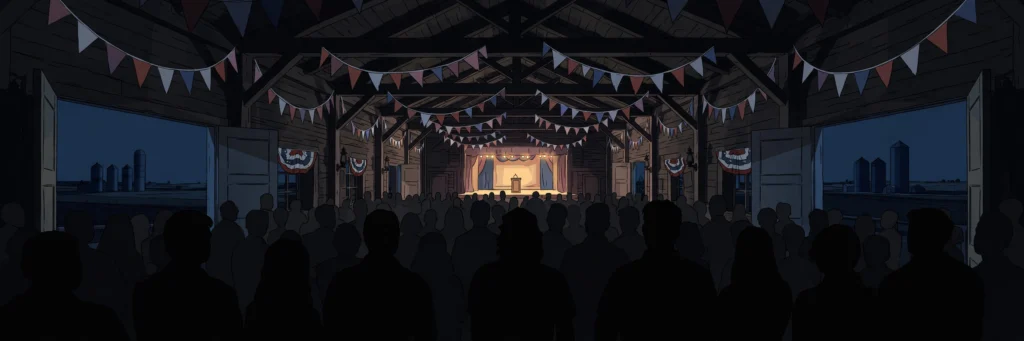
The trump rally in Salina began as a piece of political theatre. With Lee Greenwood’s song God Bless the U.S.A. playing, Trump took the stage at around 8:22 p.m. local time on Sunday, in the second stop of his campaign rally doubleheader, and told the crowd he was thrilled to be back in what he called a beautiful state. He framed the evening as the end of a long campaign, and he framed the stakes in the starkest possible terms. He had to be there, he said, to make sure Marshall got elected, and he did not want to take a chance by staying home. He could have been home watching television, he joked, but he would rather be with the crowd in Salina. It was a familiar Trump closing line, delivered with the air of a man who has spent months on the rally stage and knows that this one, the 30th, is the last.
Trump’s message to the crowd was simple, and he repeated it in several forms: get out and vote. He told the audience that all he was asking was one thing, that they turn out, because if they did, the party would have tremendous success. He told them to pretend he was on the ballot himself. That is a classic midterm device, turning a contest for Congress into a referendum on the president, and it is a device Trump has used throughout this campaign. It works by nationalising a local race, by telling voters that their choice is not just between Marshall and Hamilton but between the president’s agenda and the opposition’s. In Kansas, where Trump remains personally popular even as Marshall’s race has tightened, that framing is the campaign’s best argument.
The rally was not without incident. It was interrupted several times by protesters, who were promptly removed, and people began filtering out halfway through a speech that ran for more than 80 minutes. Those details matter because they capture the reality of a closing rally: a long speech, a restless crowd, a candidate who has been making the same argument for months and is now making it for the last time. Trump himself acknowledged the moment, telling the crowd that he did not think an experience like the rally swing would ever happen again, and urging them to go out and do what they did best, which was to win. It was a farewell as much as a pitch, and it was delivered in a state where the outcome is still genuinely uncertain.
Midterm Elections 2026: Why Kansas Matters
The midterm elections 2026 will decide control of both chambers of Congress, but the Senate is where the Kansas race matters most. Republicans currently hold a 53 to 47 majority in the Senate, which means Democrats need a net gain of four seats to take control outright, while Republicans can afford to lose a small number and still hold the chamber. Thirty-five Senate seats are on the ballot on Tuesday, and the races expected to matter most for control are in Michigan, Texas, Kansas, Iowa, North Carolina, and Alaska. Kansas belongs on that list not because it is a swing state in the usual sense, but because it has become a swing race in this particular year, in this particular political environment.
The polls explain why. Two recent surveys in Kansas tell slightly different stories, and the gap between them captures the uncertainty of the whole election. A Washington Post-Schar School poll released on Friday suggested that Hamilton, the Democrat, was leading Marshall by 52 percent to 43 percent, a nine-point margin. Another survey, from Emerson College, indicated a tighter race, with Hamilton ahead by 50 percent to 47 percent, a lead of just three points. Both polls agree on the direction of the race. They disagree, by six points, on its size, and that disagreement is the difference between a comfortable win and a race that could still go either way. For a Republican incumbent in Kansas, either number is a warning. For a Democratic challenger in Kansas, either number is an opportunity that would have seemed impossible a year ago.
The reason the race has tightened is not a single issue but a combination of them, and the campaign has been marked by a flurry of attack advertisements on both sides. Ads targeting Marshall have focused on his medical practice, and on lawsuits in which he sued hundreds of patients over unpaid bills. Ads targeting Hamilton have focused on his handling of alleged abuse at a church camp associated with his congregation. Both lines of attack are personal, both are designed to raise questions about character rather than policy, and both have shaped a race that has become as much about the candidates’ pasts as about their positions on the issues facing the Senate. Trump defended Marshall directly on the patient lawsuits, and on the 18 percent interest Marshall charged, arguing that the attacks were unfair. On the same day as the rally, the New York Times reported that Marshall had gone against the advice of his own staff and recorded an advertisement defending his actions against obstetrics and gynaecology patients who had not paid their bills. That report, arriving on the day of the president’s visit, underlined how defensive the Marshall campaign has become in the final days.
Election Polls: A Full-Court Press in Deep-Red Kansas
The election polls are only part of the story of Kansas. The other part is the sheer scale of the Republican effort to hold the seat, which has been described as a full-court press unlike anything seen before in a Kansas Senate race. Vice President JD Vance had already landed in Kansas twice to support Marshall before the president’s visit, and the final weekend brought the president himself, twice over if the earlier visit is counted, along with a national advertising blitz and a ground operation aimed at turning out every possible Republican voter. That is an extraordinary investment in a state that has not elected a Democrat to the Senate since 1932, and it is a measure of how seriously the party takes the threat.
Trump’s own framing of the Kansas race connected it to the wider campaign. Earlier on Sunday, after landing in Dubuque, Iowa, he told the travelling press pool that the party had to get the Senate, and he was flanked by House Speaker Mike Johnson and Interior Secretary Doug Burgum as he made the case. He said he was in the Midwest for Senate candidates Hinson in Iowa and Marshall in Kansas, and that the party had to make sure both got in. He also welcomed the endorsement, announced earlier on Sunday in Michigan, of Republican Senate nominee Mike Rogers by Democratic Representative Haley Stevens, who had lost the Democratic primary there to Abdul El-Sayed. That endorsement, from a Democrat crossing party lines, was presented by Trump as evidence that the Republican ticket was winning converts even in states where the party was supposed to be on the defensive.
In Salina, Trump tried to sell the crowd on policies to boost the agricultural industry, and he joked about beef, telling the audience that the country could use a little more beef and asking, with a smile, whether production could be sped up a bit. The joke landed because it spoke to a real concern in Kansas, where cattle and farming are not abstract issues but livelihoods, and where the administration’s farm policies have been under scrutiny throughout the campaign. But the bulk of the speech stuck to familiar refrains from the midterm campaign: a call for the removal of Representative Ilhan Omar from Congress, a joke about wanting to name another body of water for America, and a warning that electing Democrats would lead to higher taxes and open borders. Those are the themes that have defined Trump’s midterm rallies, and they were the themes with which he chose to close his campaign.
Republican Party News: Hamilton’s Answer
Hamilton’s response to the president’s visit came not on a rally stage but in a video, making his own final pitch directly to voters. He spoke to people who had supported Trump in the past, and to voters who had concerns about the national Democratic Party, and he presented himself as a different kind of Democrat: a pastor, a moderate, and a candidate who understood Kansas. He said he had voted for Republican President Ronald Reagan in the past, a line designed to signal to Republican-leaning voters that supporting him would not be a betrayal of their own history. It was a pitch aimed squarely at the voters the polls suggest are already moving toward him: independents, moderate Republicans, and voters who are dissatisfied with Marshall but not yet committed to a Democrat.
That pitch is the heart of Hamilton’s campaign, and it is why the race has become competitive. Hamilton is not running as a national Democrat, and he is not running on the national party’s platform. He is running as a Kansas candidate, a pastor who has spent his career in the state’s churches and communities, and who argues that the Senate needs a representative who will put Kansas first. Whether that argument can overcome the state’s deep Republican identity is the question Tuesday will answer. The polls suggest it can, or at least that it has brought him within striking distance. The Republican effort suggests the party believes it can still be stopped, but only with the president’s personal intervention in the final hours.
The Kansas race also illustrates a wider truth about this midterm campaign: that the battle for the Senate is being fought not only in the traditional battlegrounds but in states where the fundamentals favour one party and the candidates have changed the equation. In Michigan, the race has been upended by a Democratic endorsement of the Republican nominee. In South Carolina, a write-in campaign is splitting the Republican vote. In Kansas, a pastor running as a moderate has turned a safe seat into a toss-up. Each of those races is different, but they share a common feature: they are being decided by voters who are not behaving the way party strategists expected them to behave, and by candidates who do not fit the usual moulds.
What Happens Next: Tuesday’s Vote
What happens next will unfold in a compressed sequence. On Monday, the telephone rallies will take over, reaching voters in many states in the final hours before polling day, while early voting closes in the states where it has not already ended. On Tuesday, November 3, voters who have not yet cast a ballot will go to the polls, and the results will begin to show whether the national polling lead for Democrats translates into House control, whether the Senate holds for Republicans or flips, and whether the Republican full-court press in Kansas was enough to save Marshall’s seat. The Kansas result will be watched closely because it is one of the earliest indicators of the night, and because it will tell both parties whether the polls that showed Hamilton ahead were right, or whether the president’s closing visit moved enough voters to reverse them.
For Marshall, the task in the final hours is turnout: persuading Republicans who may be uneasy about the patient lawsuits, and about the tone of the campaign, that the stakes of Senate control outweigh their doubts. For Hamilton, the task is holding together a coalition that includes Democrats, independents, and disaffected Republicans, and persuading them that a vote for a pastor from Kansas is not a vote for the national Democratic Party they may distrust. For Trump, the Kansas visit was the end of a campaign that has taken him to 30 rallies across the country, and its success or failure will be judged, in part, by whether Marshall survives.
The Salina rally, then, was more than a campaign stop. It was the closing argument of a presidency’s midterm campaign, delivered in a state where the party’s hold was once assumed, in support of a senator whose seat is now genuinely at risk. Trump told the crowd he had to come to Kansas to make sure Marshall got elected, and he told them he was closing it down that night. On Tuesday, voters will decide whether that final visit was enough, and whether the battle for the senate was won or lost in a rally hall in Salina, in the last hours before the polls opened.
Source: KCUR