Breaking News Today: 9 Killed in Florida Learjet Crash
Meta description: All nine people aboard a Learjet 60 died when it crashed in Palm Beach County, Florida, on Sunday, Nov. 1, 2026, on a flight from Austin to the Bahamas.
All nine people aboard a business jet were killed on Sunday, November 1, 2026, when the aircraft came down in a residential area of Palm Beach County in South Florida and burst into flames. The jet, a Learjet 60, had departed Austin-Bergstrom International Airport in Texas and was bound for North Eleuthera Airport in the Bahamas, according to the Federal Aviation Administration. It crashed at about 12:50 p.m. Eastern time, and officials confirmed later on Sunday that no one on board had survived.
United States Transportation Secretary Sean Duffy confirmed the deaths, describing the crash as a horrific tragedy. The identities of the nine people on board had not been released by Sunday evening, and officials had not said how many were passengers and how many were crew. That restraint is normal in the first hours after a fatal crash, when families are still being contacted and investigators are still establishing who was on the manifest, but it left the most basic human questions about the victims unanswered as the day ended: who they were, why they were travelling to the Bahamas, and what had brought them together on that flight.
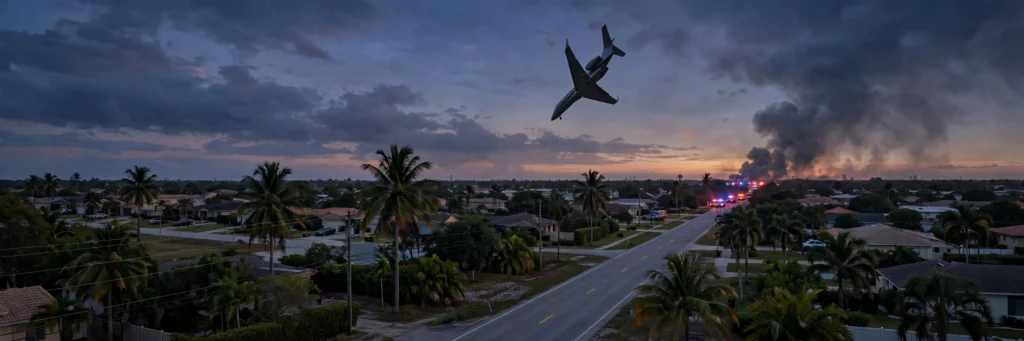
The crash happened in an unincorporated area near the communities of Greenacres and Palm Springs, in the vicinity of Military Trail and 10th Avenue North, close to a neighbourhood known as Cresthaven. It was, by every account from officials and witnesses, a violent impact. The jet struck the ground near a busy roadway, left a large crater beside the road, scattered debris across a wide area and set off several fires. Video circulating online appeared to show the aircraft hitting the ground at high speed and at a steep angle, followed by a large explosion and a fireball. Emergency crews worked through the afternoon at a scene that stretched well beyond the point of impact, as smoke rose over the neighbourhood and residents gathered at a distance to watch.
US News Today: What Happened in Palm Beach County
The location of the crash shaped almost everything about the first response. Palm Beach County is a densely settled part of South Florida, and the jet came down not in open countryside but beside homes, cars and a busy road. Florida Governor Ron DeSantis, who visited the site on Sunday, said the aircraft had looked like a missile coming down and had left a big crater on the side of the road. He also said there appeared to be no casualties on the ground, a point that officials repeated through the day: despite the force of the impact and the fires that followed, there were no immediate reports of anyone on the ground being killed or injured.
That outcome, if it holds, will owe something to where exactly the jet fell. Reports from the scene said the aircraft appeared to just miss homes before striking near the roadway, and that it had come down close to, but not directly into, the houses around it. Even so, the damage on the ground was extensive. At least one home was reported destroyed, debris was strewn across the surrounding area, and the crash scene blocked the entrance to a mobile home park, leaving about 600 people in need of shelter because they could not return to their homes while the site was secured. For those residents, the crash was not only a tragedy witnessed from nearby but a sudden displacement on a Sunday afternoon, with roads closed, emergency vehicles filling the area and no clear time given for when they would be able to go home.
The response brought together local, state and federal agencies. Palm Beach County Fire Rescue and sheriff’s deputies were among the first on the scene, joined by police officers who worked to keep the area clear while firefighters dealt with the burning wreckage and the fuel fire that followed the impact. The Federal Aviation Administration said it was sending a team to the scene to support the investigation, and the National Transportation Safety Board, which leads investigations into civil aviation accidents in the United States, was expected to have investigators on site on Sunday and Monday. A news conference was also planned for Monday in West Palm Beach, where investigators were expected to give the first official update beyond the confirmation of the deaths.
Breaking News Today: The Final Minutes Before the Crash
What happened in the air before the crash is beginning to emerge from air-traffic control recordings and flight-tracking information cited in reporting on Sunday, though officials have not yet confirmed a cause and investigators have cautioned that the full picture will take time to assemble. The picture that has emerged so far is of a flight that was proceeding normally at cruising altitude before running into trouble in difficult weather.
The aircraft was heading east at about 35,000 feet when its pilots reported turbulence, icing and precipitation, according to the recordings and reports. The crew asked to climb a further 2,000 feet, a request that suggests they were trying to get above the worst of the conditions. Instead, the aircraft entered a steep descent. Recordings cited in reporting described descent rates rising from about 10,000 feet a minute to about 20,000 feet a minute and then higher still, far beyond the rates of a normal descent, as the jet lost altitude rapidly. In the final moments, the pilot was heard issuing a mayday call and warning that the aircraft was going to crash into the ground, according to the recordings. The descent, from cruising altitude to impact, appears to have taken only a short time, and the jet was travelling at high speed and at a sharp angle when it struck the ground.
Rain had been falling heavily across the region on Sunday, and the National Weather Service had a flood watch in effect for the area because of excessive rainfall, lasting through Monday afternoon. Whether weather played a direct part in the crash, and if so how, is a question investigators will have to answer, and it would be wrong to draw a conclusion from the weather alone. Icing, turbulence and precipitation were reported by the crew, but pilots routinely fly through difficult weather, and a crash of this kind usually involves a combination of factors rather than a single cause. The recordings establish what the crew was dealing with in the final minutes; they do not, on their own, explain why the aircraft could not recover.
The aircraft itself is also part of the early record. The jet was a Learjet 60, a business jet widely used for private and charter flights, and the Federal Aviation Administration identified its tail number as N722BD. Reporting on Sunday said the aircraft was registered to a limited liability company in Delaware and was listed as available for charter online. Austin-Bergstrom International Airport confirmed that the flight was a private aircraft, but did not identify who was on board. None of that information, on its own, points to a cause, but it will form part of the record investigators assemble as they trace the aircraft’s recent history, its maintenance and its operation.
Top News Stories Today: The Investigation Takes Shape
The investigation into the crash is now in the hands of the National Transportation Safety Board, with support from the Federal Aviation Administration. That division of responsibility is standard in American aviation accidents: the safety board leads the inquiry into what happened and why, while the aviation administration supports the work and deals with any regulatory questions that arise. The board’s investigators will examine the wreckage, the flight recorders if they can be recovered intact, the air-traffic control recordings, radar and flight-tracking data, and the weather conditions at the time of the flight. They will also look at the aircraft’s maintenance history and the crew’s experience and recent duty, though officials have not yet released any of that information.
Officials were careful on Sunday not to speculate about a cause. The Federal Aviation Administration and the safety board said the cause was unknown, and the Transportation Secretary’s statement confined itself to confirming the deaths and the agencies’ roles. That caution matters, because early speculation after aviation accidents is often wrong, and because the families of the victims, and the people who live near the crash site, deserve an account based on evidence rather than guesswork. The Monday news conference in West Palm Beach is expected to be the first opportunity for investigators to set out, in their own words, what they have found so far and what they still need to establish.
One question that will be asked repeatedly in the coming days is whether anyone on the ground was hurt. On Sunday, the answer from both the governor and the Transportation Secretary’s office was that there were no immediate reports of ground casualties, and the governor said at the scene that there appeared to be none. That assessment could change as the debris field is fully searched and as hospitals report, but for now the confirmed toll stands at the nine people on board. The displacement of the mobile home park residents is a separate and continuing consequence: with the crash scene blocking the entrance to their community, hundreds of people needed shelter on Sunday night, and local officials were working to find them somewhere to stay until the site could be cleared and the road reopened.
Live News Updates: Why This Crash Stands Out
Sunday’s crash is already being placed in a grim national context. According to National Transportation Safety Board records cited in reporting, it is the second deadliest aviation crash in the United States this year, after a skydiving plane crash in Butler, Missouri, in June that killed twelve people. It is also, according to data from the Flight Safety Foundation cited in reporting, the worst crash involving a Learjet 60, a type of aircraft that has been in service for decades and is a familiar sight at airports across the country.
Those comparisons do not explain the crash, but they explain why it has drawn national attention beyond South Florida. A crash that kills nine people in a single incident, in a residential area, on a Sunday afternoon, with video of the final moments circulating widely online, is the kind of event that stops people in their tracks, whatever the eventual cause turns out to be. It also raises questions that go beyond this one flight: about the safety of private charter operations, about flying in severe weather, and about how close residential communities in South Florida sit to the paths of aircraft heading out over the Atlantic towards the Bahamas. None of those questions can be answered responsibly until the investigation has run its course, but they are the questions that investigators, regulators and the public will be asking in the days ahead.
For the families of the nine people who died, the national context will matter far less than the personal loss, and far less than the wait for official confirmation of who was on board. That wait is one of the hardest parts of the aftermath of any fatal crash, and officials gave no timetable on Sunday for when names would be released. The usual practice is to withhold names until families have been notified, and in a case involving a private flight with passengers travelling together, that process can take time, particularly when the wreckage and the fire have made identification difficult. What is known is that nine people boarded a jet in Austin on Sunday morning, or early afternoon, bound for the Bahamas, and that none of them survived the flight.
What Happens Next in Palm Beach County
In the immediate term, the focus remains on the crash site itself. Investigators arriving on Sunday and Monday will document the wreckage and the debris field, secure any recorders and begin the painstaking work of reconstructing the flight’s final minutes from the physical evidence and the recorded data. The road around the site will remain closed while that work goes on, and the residents displaced from the mobile home park will need somewhere to stay until it is safe for them to return. Local officials will also have to deal with the damage to homes and infrastructure near the impact point, and with the clean-up of fuel and debris that a crash of this kind leaves behind.
Beyond the site, the next public milestone is the news conference planned for Monday in West Palm Beach, where the National Transportation Safety Board is expected to give its first briefing. That briefing is unlikely to establish a cause: safety board investigations typically take months to reach a final conclusion, and early briefings usually confine themselves to the facts that have been confirmed, the evidence that has been recovered and the lines of inquiry that investigators are following. But it will be the first chance for officials to speak on the record about what they have found, and for the families and the public to hear directly from the people leading the investigation.
For now, the confirmed facts are these: a Learjet 60 carrying nine people left Austin for the Bahamas on Sunday, November 1, 2026; it crashed at about 12:50 p.m. Eastern time in Palm Beach County, near Greenacres and Cresthaven, in the area of Military Trail and 10th Avenue North; all nine people on board were killed; no casualties on the ground had been reported by Sunday evening; and the Federal Aviation Administration and the National Transportation Safety Board are investigating, with the safety board in the lead. Everything else — the role of the weather, the reason for the steep descent, and the identities of the victims — remains to be established, and this article will be updated as officials confirm more.
Source: CNN, USA Today, Reuters, Al Jazeera