Midterm Elections 2026: Trump Reflecting Pool Pitch
Meta description: Trump will deliver his midterm elections 2026 closing pitch at the Lincoln Memorial Reflecting Pool on Monday, after rallies in Iowa and Kansas.
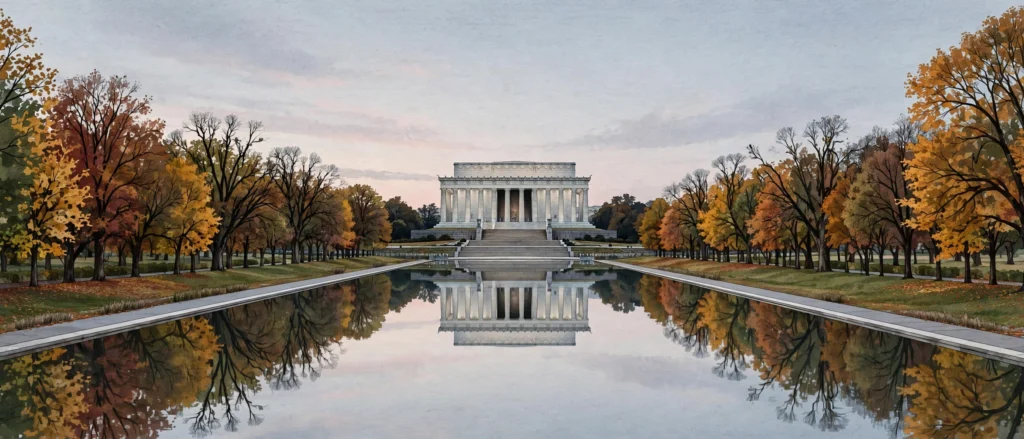
President Donald Trump signalled on Sunday that the final message of his midterm elections 2026 campaign would not be delivered in a battleground state, in a packed arena, or at a rally hall in the Midwest. Instead, it would be delivered in Washington, at the Lincoln Memorial Reflecting Pool, a landmark whose recent restoration has become a running embarrassment for his administration. The choice, reported by the Associated Press from comments Trump made to reporters as he stepped off Air Force One for a rally in Iowa, turns a familiar closing-week ritual on its head. For more than a month, Trump has travelled from state to state, staging rally after rally in largely conservative areas in an effort to lift Republican candidates. Now, with voting just two days away, he is preparing to make his last appeal from the capital itself, standing beside a pool that was supposed to be fixed quickly and cheaply, and that instead took months longer than promised, cost far more than first estimated, and then developed problems that were visible to anyone who looked at it.
Trump told reporters that speaking at the site would show how beautiful it is, and suggested that the event might take place the following day, without giving firm details at that moment. A White House official later confirmed to USA Today that the president would deliver remarks at the Reflecting Pool near the Lincoln Memorial on Monday, November 2. The timing matters because it places the speech on the final full day before Election Day on Tuesday, November 3, when voters will decide all 435 seats in the House of Representatives and 35 seats in the Senate, and with them control of Congress for the remaining two years of Trump’s presidency. It also creates an odd sequence in Trump’s own public statements. In a post on his social media platform before landing in Iowa, he had described his Sunday evening rally in Kansas as his last stop. That description sat uneasily alongside the Washington plan, and it left open whether the Kansas rally was meant as his last campaign rally in the traditional sense, with the Reflecting Pool event serving as a separate, more formal closing statement from the seat of government. What is clear is that the Washington event is now the planned finale, and that it will be judged both as a political speech and as a showcase for a restoration project that has already been judged, harshly, in public.
The decision is unusual for another reason. A closing rally in a contested state is designed to do a specific job: energise supporters, dominate local television coverage, and give a candidate a final image of presidential backing. A speech in Washington does something different. It speaks to a national audience, it borrows the authority of a national monument, and it invites comparison between the president’s record and the setting he has chosen. In this case, that comparison is unavoidable, because the Reflecting Pool is not a neutral backdrop. It is a project Trump personally championed, personally described, and personally defended, and its troubled history is now part of the story of his closing pitch whether he wants it to be or not.
Midterm Elections 2026: Why the Closing Message Matters
The midterm elections 2026 will determine who controls Congress for the second half of Trump’s term, and that is why the closing message carries weight far beyond a single speech. If Republicans hold the House and the Senate, the president retains a legislative path, however narrow, for the rest of his time in office. If Democrats take one or both chambers, his agenda faces a very different future, with oversight, investigations, and a much harder route to passing legislation. That is the standard midterm calculation, but this cycle has its own pressures. The Associated Press reporting on Trump’s weekend travel noted that the president is campaigning against the background of his own low approval ratings, and against polls suggesting that public concern over the Iran war, high energy prices, and rising living costs could produce a strong election night for Democrats. Those are not the conditions in which a governing party coasts to victory, and they help explain why Trump has spent the final month on the road, staging more than 25 rallies in an effort to turn out his supporters.
Trump news in the closing days has therefore been dominated by turnout, not persuasion. Midterm elections are often decided by which side’s voters actually show up, and a presidential rally is one of the loudest available tools for getting supporters to the polls. The early voting figures underline how much of the election has already happened before the final speeches are even given. An Associated Press analysis cited in weekend coverage put the number of people who had already voted at more than 54 million. That figure means the closing pitch is not really an introduction to the campaign for most voters. It is a final nudge to the remaining electorate, and a message aimed at shaping how the result is understood on election night and in the days that follow. A speech from Washington, rather than from a rally hall, frames that message as a statement from the presidency itself, not just from a campaign.
The battle for the Senate is at the centre of that calculation, and so is the battle for the House, because both chambers are in play at the same time. Thirty-five Senate seats and every House seat are on the ballot, and the result will shape not only legislation but also confirmations, oversight, and the political environment for the next presidential contest. In that context, the choice of venue is a message in itself. A rally in a swing district says that the fight is local and urgent. A speech at a national monument says that the fight is about the country as a whole, and about the record of the administration that governs from the capital. Trump has chosen the second framing for his finale, and he has chosen a monument whose restoration he has presented as evidence of what his administration can do in Washington. Whether voters see it that way, or whether they see a project that ran late and over budget, is the question that will follow the speech.
Voter turnout will be the practical test of the strategy. Early voting has already been heavy, and both parties have spent the final weekend trying to reach the voters who have not yet cast a ballot. A Washington speech, broadcast nationally, can reach those voters wherever they live, but it cannot replicate the local energy of a rally in their own state. That trade-off is part of what makes the decision so striking. Trump has spent weeks travelling to conservative areas where his support is strongest, building momentum through sheer repetition. Ending that tour in Washington, rather than in a final battleground, suggests a calculation that the national message now matters more than one more local appearance, or that the symbolism of the Reflecting Pool itself is worth the departure from the usual pattern.
Trump Rally: From Dubuque and Salina to Washington
The road to the Reflecting Pool ran through Iowa and Kansas on Sunday, and those two rallies explain how the closing weekend unfolded. Trump spoke for about two hours in Dubuque, Iowa, at the Five Flags Event Center, campaigning for Republican Senate nominee Ashley Hinson and Republican gubernatorial nominee Zach Lahn, two days before Iowa voters settle both open races. He then travelled to Salina, Kansas, for a second rally on the same day, supporting Senator Roger Marshall and other Kansas Republicans. The Dubuque and Salina stops were the latest in a month-long sequence of more than two dozen in-person rallies, most of them in areas where Republican support is strong, and they followed a confused build-up in which the Dubuque visit was at one point reported as cancelled and replaced by a telephone rally, before the in-person event was restored. By Sunday, the schedule had settled into back-to-back rallies, and the president’s remarks in both states were framed as part of a final push to hold Congress.
The Dubuque rally also became the stage for a national story from Michigan, where Democratic Representative Haley Stevens had earlier on Sunday broken with her party to endorse Republican Senate nominee Mike Rogers over Democratic nominee Abdul El-Sayed, after losing the Democratic primary to El-Sayed. Trump praised Stevens at the rally, called her endorsement brave and a significant move, and urged her to join the Republican Party, while attacking El-Sayed in terms that news reports described as hostile. That episode, covered in detail in the previous staged article on the Dubuque rally, gave the final weekend a fresh national hook, and it showed how a local rally can become a platform for a message aimed far beyond the state where it is held. The Reflecting Pool speech continues that pattern, but on a larger stage. Where Dubuque was about Iowa’s Senate and governor races, Washington will be about the national campaign as a whole.
The contrast between the two settings is also a contrast in tone. A trump rally is loud, partisan, and built around the energy of a crowd. A speech at the Lincoln Memorial is quieter, more formal, and loaded with historical associations that no campaign can fully control. The Lincoln Memorial has been the backdrop for some of the most famous speeches in American history, and it carries expectations that a rally hall does not. Trump has used the memorial setting before in his political career, but the Reflecting Pool adds a specific complication, because the pool itself is not just a backdrop. It is a project with a history, a budget, and a set of problems that have been reported in detail, and any speech delivered beside it will inevitably be read against that history. Supporters may see a restored landmark and a president presenting his work. Critics will see a project that took too long, cost too much, and still ran into trouble after it was declared finished.
That tension is part of why the announcement attracted so much attention on Sunday. It was not simply that Trump had chosen a venue. It was that he had chosen a venue he had already made into a story, and that he was choosing it for the most important speech of the midterm campaign. The decision suggests confidence that the pool now looks good enough to serve as a showcase, and that the visual of a restored Reflecting Pool will outweigh the memory of algae, peeling paint, and disputed explanations. It also suggests a willingness to invite scrutiny, because reporters and photographers will be looking closely at the water, the liner, and the surrounding area, and any flaw will be part of the coverage. In a campaign that has been fought largely through images as well as arguments, that is a gamble, and it is one Trump appears willing to take.
The Reflecting Pool Restoration: A Troubled Project
The Reflecting Pool saga began in April, when Trump said he wanted to change the colour of the pool and would use contractors he knew to fix the monument in a matter of days, for about 1.5 million dollars, before Independence Day. That was the original promise: fast, inexpensive, and completed in time for the summer. The reality was very different. The repairs finished nearly three months behind schedule, and the budget grew to more than ten times the early estimate, according to the Associated Press account of the project. That gap between promise and outcome is the core of the story, and it is why the pool has become a symbol in coverage of the administration’s approach to public works. A project presented as a simple, quick fix became a long, expensive, and contested restoration, and the reasons for that transformation have been disputed ever since.
Trump initially declared the work complete in June. Soon afterwards, however, the pool was affected by algae blooms, and the blue liner that had been described as American-flag blue began peeling off in sections. Those problems were visible and widely reported, and they undermined the claim that the work was finished. Trump repeatedly blamed vandals for the damage, suggesting that the pool had been deliberately harmed after the restoration. That explanation was challenged by the office of the United States Attorney for the District of Columbia, led by Jeanine Pirro, a former television host and longtime Trump ally, which said the problems were caused by shoddy workmanship rather than vandalism. The disagreement matters because it goes to the heart of the project: whether the faults were the result of outside interference, or whether they were built into the work itself. Pirro’s assessment, coming from an ally rather than a critic, carried particular weight, and it has shaped how the restoration is now understood.
The pool itself has a longer history that Trump has invoked in defending the work. He has said that the pool has not worked properly since it was built in the 1920s, that it has always leaked badly, and that the restoration has finally made it function as it should. He has also pointed to security cameras added after the vandalism claims, presenting them as evidence that the site is now protected. Those claims are part of a broader argument that the project, whatever its problems, has delivered a working landmark where previous efforts had not. Critics, by contrast, focus on the cost, the delay, and the post-completion problems, and argue that a project that was supposed to take days and cost a little over a million dollars should not have become a months-long effort costing many times that amount, only to need further attention after it was declared done. Both arguments will be in the background when Trump speaks on Monday, and the pool itself will be the evidence that audiences judge.
The restoration also sits within a wider programme of work in the capital that Trump has described as restoring the city, and the Reflecting Pool speech is expected to touch on that theme. The phrase has been used to describe efforts to renovate landmarks, improve public spaces, and present Washington as a capital that reflects the administration’s standards. Whether that programme is seen as a success or as a series of troubled projects depends on which examples are chosen, and the Reflecting Pool is now the most prominent example of all, precisely because it has been so contested. A speech beside it is therefore not just a speech about the midterms. It is also, implicitly, a speech about the restoration, and about whether the administration’s work in Washington should be judged by its intentions, by its finished appearance, or by the messy process that got it there.
What Happens Next: Monday Speech and Tuesday Vote
What happens next is now clear in outline, even if the details of the speech itself are not yet known. Trump will deliver remarks at the Reflecting Pool on Monday, November 2, in what is billed as his closing message before the midterms. The speech will come after a final weekend of rallies and telephone outreach to Republican voters, and it will be followed almost immediately by Election Day itself. Voters in Iowa, Michigan, Kansas, and every other state with contested races will then decide the outcome, and the result will be read as a verdict not only on the candidates, but on the president’s record, his campaign, and the closing argument he chose to make from Washington. The speech is therefore the last scheduled opportunity for Trump to shape that verdict before ballots are counted, and its content will be scrutinised for what it emphasises, what it omits, and how it frames the choice facing voters.
The most important question for Tuesday is whether the closing message moves any voters who have not already decided, or whether it mainly serves to consolidate support that is already there. With more than 54 million ballots already cast before the final weekend, the pool of remaining voters is smaller than it would have been in an earlier era, but it is still large enough to matter in close races. In the Senate, where 35 seats are contested, a handful of close contests could decide control of the chamber. In the House, where all 435 seats are at stake, the aggregate result across dozens of districts will determine the majority. A national speech can speak to all of those races at once, but it cannot tailor its message to each one, and that is the inherent limitation of a Washington finale. It trades local specificity for national reach, and it bets that the national argument is the one that will matter most on election night.
For the Reflecting Pool itself, Monday will also be a test of a different kind. The cameras will show the water, the liner, and the memorial, and the images will travel far beyond Washington. If the pool looks clean, still, and restored, the visual will support the president’s claim that the project is finished and beautiful. If there are visible problems, they will become part of the story, just as algae and peeling paint did in the summer. That visual test is inseparable from the political test, because Trump has chosen to link them by choosing this venue. He has, in effect, put the restoration on the ballot alongside the candidates, at least for one news cycle, and he has invited voters and reporters to judge both at the same time.
Beyond Tuesday, the consequences will unfold quickly. A Republican hold on Congress would preserve the president’s legislative options and his ability to advance his agenda in the final two years of his term. A Democratic gain in either chamber would change the balance of power, increase oversight, and reshape the political landscape for the next presidential election. Either way, the Reflecting Pool speech will be remembered as the moment when Trump chose to end his midterm campaign not in a battleground, but in the capital, beside a project that embodies both his ambitions for Washington and the controversies that have accompanied them. It was a choice that said as much about how he wants his presidency to be seen as about the election itself, and that is why it has already become one of the defining images of the closing days of the 2026 midterms.
Source: AP News