Trump Rally Dubuque: Final Iowa Push Before Midterms
Meta description: Trump returned to Dubuque on Sunday for a final Iowa rally with Ashley Hinson and Zach Lahn, two days before the 2026 midterm elections.
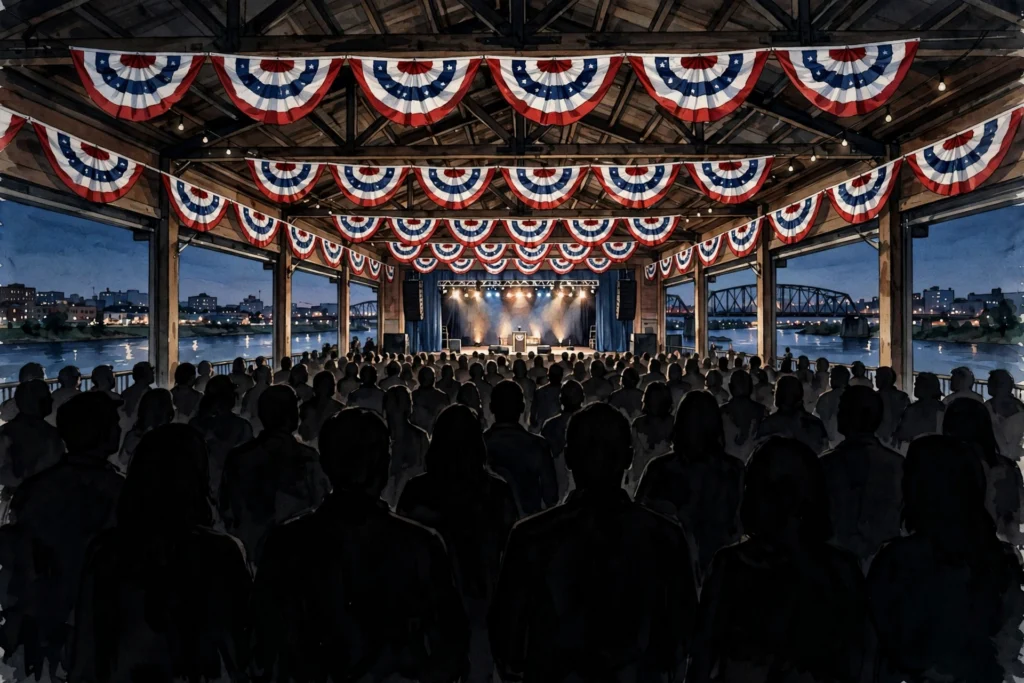
The final trump rally of Iowa’s midterm weekend took place on Sunday, November 1, 2026, in Dubuque, where President Donald Trump campaigned for Republican Senate nominee Ashley Hinson and Republican gubernatorial nominee Zach Lahn. The Gazette framed the stop as the final push in Iowa, with Hinson and Lahn rejoining Trump on stage in the Mississippi River city, and the timing left no doubt about what was at stake. Voters go to the polls on Tuesday, November 3, and the races Trump came to boost will help decide whether Republicans keep control of the Senate and how much ground they hold in the House during the final two years of his presidency. Dubuque, in Iowa’s second congressional district, was a deliberate choice for that closing argument: a river city in the eastern part of a state where Republicans have dominated recent statewide contests but where both top-of-ticket races this year are genuinely competitive.
Trump’s appearance in Dubuque was his second Iowa rally in ten days. He had campaigned in Sioux City on October 22, focusing on turnout in the fourth congressional district, where nearly half of all registered voters are Republicans. The Dubuque stop shifted the map eastward, to a district with a different political complexion and a four-way House contest of its own, between Democrat Lindsay James, Libertarian Rick Stewart, independent Dave Bushaw and Republican Joe Mitchell, who had appeared on stage with Trump at Sioux City. The through-line of both visits was turnout. In the closing days of a midterm campaign, a presidential rally is less about persuading undecided voters in the hall than about energising the base, dominating the local news cycle, and giving down-ballot candidates a closing image of national backing that their own advertising cannot buy.
Midterm Elections 2026: Why Iowa Matters on Tuesday
Iowa matters in the midterm elections 2026 for an unusual reason: both of its marquee races are open seats at the same time. Hinson, currently a member of the House, is running for the Senate seat being vacated by retiring Senator Joni Ernst, facing Democratic state representative Josh Turek. Lahn, a businessman and farmer from Belle Plaine, is running for governor against Democratic state auditor Rob Sand, because Governor Kim Reynolds is not seeking a third term. It is the first open gubernatorial election in Iowa since 2006, and the first time an open governor’s race has coincided with an open Senate race in the state since 1968. That double vacancy is why a single Sunday rally could plausibly matter for two campaigns at once, and why both nominees wanted to be seen beside the president in the final 48 hours.
The Senate race is the more nationally watched of the two, because it feeds directly into the battle for the Senate. Hinson worked to warm up the Dubuque crowd before Trump arrived, telling supporters that the deluge of television advertisements would end in just two and a half days, and warning that a win for Turek would put Democratic leader Chuck Schumer in charge of the Senate. That framing, that the Iowa race is not only about Iowa but about who runs the chamber, is the standard closing pitch of a midterm campaign, and it was echoed in the way Trump himself treated the event. He did not confine his remarks to Iowa at all. As the day developed, the rally became a stage for a national story from Michigan, where a Democratic congresswoman had broken ranks to endorse a Republican Senate candidate, and Trump used the Iowa platform to praise that defection and urge the congresswoman to switch parties altogether.
The governor’s race, by contrast, is a contest about who runs Iowa itself, and it has been fought largely on state issues. Lahn won the Republican nomination in an upset in June, taking 37.65 percent of the vote in a five-candidate primary even though Representative Randy Feenstra had entered the race as the frontrunner with Trump’s endorsement. Sand, the only Democrat to qualify for his party’s primary ballot, has led in polling through the autumn: the RealClearPolitics average cited in late October put him ahead by 6.2 percentage points, 50.6 percent to 44.4 percent. Both candidates have campaigned on the cost of living and on Iowa’s high cancer rates, while disagreeing sharply on schools, taxes and cultural issues, and Reynolds herself praised Lahn as the clear winner of their final debate in Cedar Rapids. For Lahn, standing with Trump in Dubuque in the final weekend was a chance to consolidate the Republican base that had split in the primary and to close a polling gap in the last days.
Trump News: The Rally That Was Cancelled, Then Restored
The Dubuque rally almost did not happen in person at all, and its on-again, off-again history became part of the story. On October 30, reports said Trump had cancelled Sunday’s in-person rally in Dubuque and would speak at a telephone rally instead, with the Republican National Committee saying he would reach Iowa voters by telephone broadcast in support of Hinson, Lahn and other Iowa Republicans. The plan at that point was for tele-rallies in Iowa and 18 other states in the 72 hours before Election Day, a schedule built for reach rather than for the spectacle of a hall. By Friday, however, the in-person visits were restored, and the final-weekend schedule settled into back-to-back rallies in Dubuque and Salina, Kansas, on Sunday, with Trump campaigning for Hinson and Iowa Republicans before heading to Kansas to support Senator Roger Marshall and other Kansas Republicans.
The restoration did not remove all confusion. Campaign listings scheduled Trump’s Dubuque remarks for 3 p.m. Central time, while the Five Flags Event Center venue listing gave an earlier time, and both events required advance registration. The Kansas rally, originally scheduled for Saturday, October 31, was moved to Sunday alongside the Iowa event. The whiplash of cancellation and restoration is characteristic of a final-weekend schedule assembled under pressure, and it also explains why local reporting on Sunday carried two tones at once: the rally itself as a set-piece event, and the organisational scramble behind it as a story in its own right. For supporters who had registered, the practical question was simply whether the doors would open as listed; for the campaigns, the restored visit was a reprieve, a chance to stage the closing image they had planned.
One smaller dispute from the Dubuque stop illustrated how even the staging of a rally can become news. City officials in Dubuque removed a tarp that had covered a solidarity mural on the building where Trump was holding his rally, the city-owned Five Flags Civic Center, after reports that Trump’s advance team had placed the tarp over the mural. The city said in a statement late on October 31 that it had removed the covering. The episode was minor beside the election itself, but it captured something real about the final weekend: in a city-owned venue, in a contested district, even the walls behind the stage are contested ground, and local government can find itself refereeing the symbolism of a national campaign visit.
Battle for the Senate: Hinson, Turek and a Personal Opening
Trump opened his Dubuque remarks by talking about Hinson herself, and in terms that immediately drew attention. According to the Wall Street Journal’s account of the rally, he began by discussing Hinson’s weight loss since she was first elected to the House in 2020, saying he had known her for a long time and that she had shed the weight in the traditional way, without medication, and presenting that discipline as evidence of her commitment to running for office. USA Today’s live coverage reported the same opening in similar terms, noting that Trump said he had known Hinson when she was heavier and that she had lost the weight for Iowa voters. The president has made comments about the physical appearances of Senate candidates a staple of his 2026 midterm stump speeches, USA Today noted, and he had not made such comments about Hinson at his rally in Iowa the previous month. The opening was, in other words, both personal and patterned: a signature Trump rally device, applied to a candidate he was trying to carry over the line.
Beyond that opening, the rally’s message was conventional closing-week material. Hinson’s warning about Schumer, Trump’s presence beside both statewide nominees, and the emphasis on turnout all pointed to the same calculation: in a midterm, the party that gets its voters to the polls wins, and a presidential visit is the loudest available turnout tool. Early voting figures gave both sides something to argue about. One Iowa tracking site, drawing on the Secretary of State’s October 30 report, put ballots received statewide at 407,549, up 39.3 percent on the same point in 2022, with Democrats accounting for 47.1 percent of those ballots by registration, Republicans 33.8 percent and voters with no party 18.8 percent. Registration, of course, is not a vote count, and both parties have learned to be cautious about reading early ballots as results. But the volume itself was a sign of an engaged electorate, and it framed the final weekend as a contest for the remaining voters rather than a coronation for either side.
Republican Party News Meets Democratic Party News: The Stevens Defection
The most consequential political development of Sunday did not happen in Iowa at all, but Trump made it part of the Dubuque rally. Earlier in the day in Michigan, Democratic Representative Haley Stevens, who lost the state’s Democratic Senate primary in August to Abdul El-Sayed, broke with her party and endorsed El-Sayed’s Republican opponent, former Representative Mike Rogers. Stevens, who represents areas outside Detroit, appeared with Rogers at a church service at Perfecting Church on Detroit’s east side, then posted a video announcement on social media saying that El-Sayed had told her she was no longer welcome in his campaign and should stay away, and that she agreed and did not belong in his campaign. The two had initially been scheduled to appear together at a different Detroit church on Sunday with Democratic Representative James Clyburn of South Carolina, but that plan collapsed after Stevens demanded on October 30 that El-Sayed condemn an advertisement from an outside political action committee that she described as antisemitic, an ad blaming rising prices on American military support for Israel.
The reaction inside the Democratic Party was swift and furious. Senate Minority Leader Chuck Schumer, who had said in June that Stevens had the best chance of beating Rogers, called her endorsement a despicable betrayal. The chair of the Michigan Democrats’ Black caucus said Stevens had revealed herself as a sellout who had lost her way, and other Democrats denounced her as a traitor. Stevens’ own camp frayed in public: her chief of staff and communications director quit after the endorsement, according to reports. El-Sayed himself brushed the announcement aside, saying he thought less about Stevens than about the millions of other Michiganders, and that his focus remained the cost of living and other issues facing voters. Rogers, standing beside Stevens at a press availability, said he was proud and honoured to earn her vote, and added that he was glad he was not running against her.
Trump, speaking in Dubuque, seized on the defection. USA Today reported that he praised Stevens, calling her endorsement brave and a big move, urged her to join the Republican Party, and launched a series of attacks on El-Sayed that news reports described as Islamophobic. The Guardian’s video report on the day carried the same account: praise for Stevens’ defection paired with insults aimed at El-Sayed. The episode matters beyond its drama because Michigan is one of the battleground Senate races that could decide control of the chamber. Most polls put El-Sayed narrowly ahead of Rogers going into Election Day, according to the Straits Times, while the prediction market Kalshi priced El-Sayed at 68 percent and Rogers at 32 percent on Sunday afternoon, with El-Sayed’s price falling about eight points within hours of Stevens’ announcement. Whether a late endorsement by a defeated primary rival moves votes, or merely moves markets and headlines, is the open question, but it gave Trump’s final-weekend message a fresh national hook that had nothing to do with Iowa.
Voter Turnout and Early Voting: What Happens Next
The calendar after Dubuque is short and unforgiving. Trump was scheduled to attend the Kansas rally in Salina on Sunday evening, to deliver remarks at the Reflecting Pool near the Lincoln Memorial on Monday, November 2, according to a White House official cited by USA Today, and to continue a programme of telephone rallies aimed at Republican voters across the country. Then comes Tuesday, when Iowa voters will settle both open races, Michigan voters will settle the Stevens-Rogers-El-Sayed triangle, and voters nationwide will decide control of the House and Senate for the remaining two years of Trump’s term. In Michigan, early voting had already ended on Sunday, with more than two million early ballots cast, and the same turnout machinery that produced Iowa’s elevated early ballot numbers will produce the final result.
What to watch on election night starts with the two Iowa races Trump came to boost. A Hinson victory would protect a Republican Senate seat in a state the party has carried comfortably in recent presidential cycles, and would blunt Democratic hopes of a Senate majority built on open seats. A Lahn victory against the polling average would be the bigger surprise, and would give Republicans the Iowa governor’s office for a further term despite an open race and a well-funded Democratic opponent. A Sand victory, conversely, would make him the first Democrat elected governor of Iowa since Chet Culver in 2006, and would be read nationally as evidence that even Republican-leaning states are in play in a midterm backlash. In Michigan, the question is whether Stevens’ defection peels away any of the establishment Democratic voters she once represented, or whether it hardens support for El-Sayed among voters who resent a late party split.
For now, the Dubuque rally stands as the closing image of the Iowa campaign: a restored in-person visit, a president campaigning for two nominees at once, a local mural dispute, a personal opening about one candidate, and a national endorsement drama imported from Michigan into an Iowa hall. It was, in that sense, a fitting final-weekend event for a midterm cycle in which local races and national storylines have become impossible to separate. The speeches are over. The television advertisements, as Hinson promised her crowd, are about to end. What remains is the vote itself, and the counting that will show whether the final push in Dubuque pushed anyone at all.
Source: The Gazette