Election Polls: Democrats Lead as Early Voting Surges
With three days left before Americans vote in the 2026 midterms, the election polls point in one clear direction nationally, while the early voting figures point in another, equally striking one: toward a turnout surge that is already reshaping the final weekend of the campaign. Democrats hold a lead of more than eight points on the national congressional ballot, according to the latest polling average, and tens of millions of voters have already cast a ballot, far ahead of the pace set at the same stage in 2022. Neither fact, on its own, decides anything. A national lead does not translate neatly into seats, because House races are fought district by district and Senate races state by state, and an early ballot tells observers nothing about which candidate the voter chose. Taken together, though, the two sets of numbers describe an election that is both highly energised and unusually lopsided in its national mood, with the fight for control of Congress now concentrated in a handful of states where the margins are much tighter than the national picture suggests.
The stakes are familiar from every midterm, and they are high. Voters on Tuesday, November 3, will decide control of the House of Representatives and the Senate, and with it how much of President Donald Trump’s agenda can move through Congress in the final two years of his term. Republicans are defending a narrow 53 to 47 majority in the Senate, while Democrats need only a small net gain in the House to take control there. History favours the party out of the White House at a midterm, and the current polling fits that pattern. What makes this year different is the scale of the early vote, which means that by the time the final rallies are held on Sunday, a very large share of the electorate will already have made its choice, and the remaining campaign will be as much about energising volunteers and dominating the news as about persuading the undecided.
Election Polls: The National Picture
The headline number in the latest election polls comes from RealClearPolling’s national congressional ballot average, which puts Democrats on 51.4 percent and Republicans on 43.2 percent, a gap of 8.2 percentage points. That average smooths out the differences between individual surveys, and it has been stable enough in recent days to be treated as the best single summary of the national mood. It does not mean Democrats will win 51.4 percent of the seats, because votes are not distributed evenly across the country, and because the House map rewards geographic spread as much as raw vote share. But a lead of that size, if it held on Election Day, would be consistent with a substantial Democratic gain in the House.
A separate survey, from the Economist and YouGov and released on Thursday, measured something different: not how people intend to vote, but what outcome they expect. Forty-four percent of registered voters in that survey expected Democrats to control the House after the election, against 31 percent who expected Republicans to keep it. For the Senate, expectations were far closer, with 39 percent expecting a Democratic majority and 36 percent expecting a Republican one. The gap between the two chambers in voters’ expectations mirrors the gap in the analysis offered by election watchers. Kyle Kondik, managing editor of Sabato’s Crystal Ball at the University of Virginia Center for Politics, has argued that a large Democratic lead on the generic House ballot makes a change of control in the House look very likely, while the Senate remains genuinely open. The Senate map, with its mix of states up for election this year, gives Republicans more room to hold on even in a year when the national vote moves against them.
That distinction, between the House and the Senate, is the key to reading the rest of the campaign. The battle for the House is a national story, driven by the overall mood, by approval of the president, and by economic concerns that surveys consistently show weighing on voters. The battle for the Senate is a collection of state stories, each with its own candidates, its own local issues, and its own polling. A voter in Texas or Kansas may be part of the same national wave, but the race they decide will turn on the two names on their own ballot. That is why the national lead, striking as it is, has not produced complacency in either camp, and why both parties are spending the final weekend in the states where the Senate will actually be decided.
Early Voting: A Surge Before Election Day
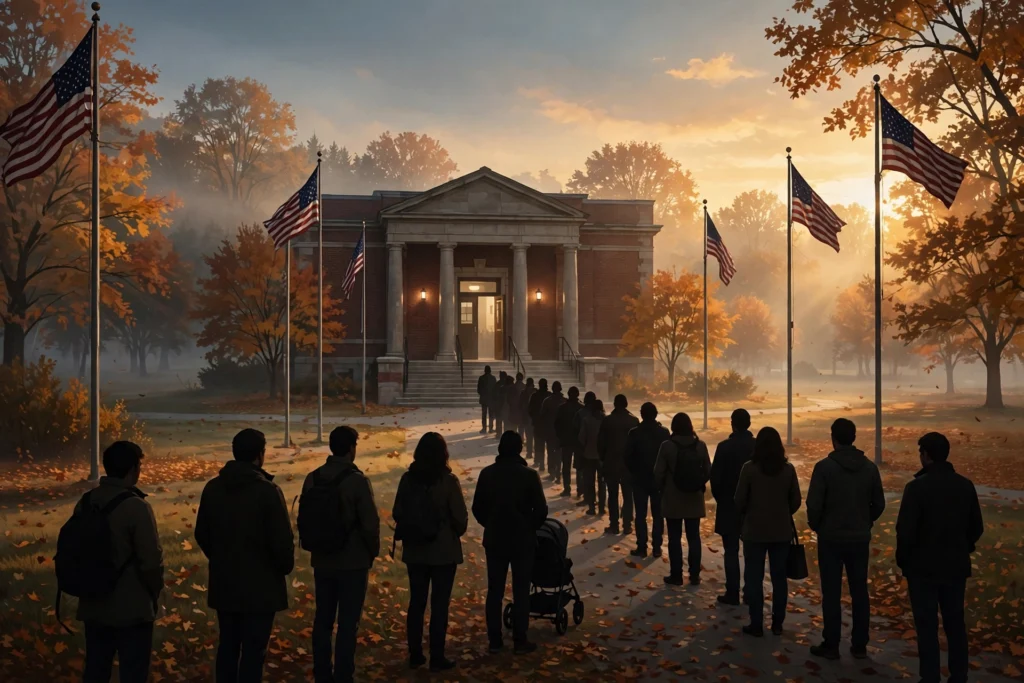
If the polls describe the mood, the early voting numbers describe the energy. According to an analysis by the Associated Press released on Friday, more than 43 million Americans had already voted early in person or returned a mail ballot five days before Election Day. That is nearly 10 million more than at the same point before the 2022 midterms, a jump that stands out even allowing for the growth of early voting as a habit. The increases have been largest in states with competitive Senate races, which is exactly where campaigns have been working hardest to get their supporters to the polls early, and where voters have had the most reason to pay attention.
Texas offers the clearest example. More than 6.3 million Texans had voted early as of Wednesday, compared with 4.2 million at the same stage in 2022, an increase of 50 percent. Reporting from Houston on Friday described voters still arriving at polling stations as the state’s early voting period drew to a close, a sign that the surge was continuing into the final days of early voting rather than fading. Georgia tells a similar story on a smaller scale. More than 2.5 million ballots had been cast there by Friday morning, already passing the 2.3 million recorded across the whole early voting period in 2022. Reporting from Atlanta described long queues at polling stations and noticeably stronger participation among younger voters, some of whom spoke about wanting a better future for the next generation and about the role of social media in drawing attention to the election.
The pattern extends beyond the two largest states in the spotlight. Early voting was also up by more than 30 percent on the same point in 2022 in Maine, Michigan, North Carolina and Kansas, according to the Associated Press analysis. Those are very different states, politically and geographically, which makes the breadth of the increase significant. It suggests that the surge is not driven by a single race or a single state’s rules, but by a wider sense that this election matters, a sentiment that Democratic strategists have also picked up in their own research, with voters describing a desire for change and a hope, sometimes a frustrated one, that those they elect will act on it. Turnout, in other words, is high across the map, not just where the cameras are.
There is, however, an important limit to what these numbers can show. Early voting totals record who has voted, not how they voted, and they say nothing certain about the final result. A state can set an early voting record and still be won by either party, because the composition of the early electorate changes from year to year and because Election Day itself still brings out millions more voters. Analysts who study early voting warn against reading party advantage into raw totals, and the campaigns themselves know that the voters who have already cast a ballot are no longer available to be persuaded. The surge matters most as evidence of engagement, and as a warning to both parties that the electorate they face on Tuesday will be larger, and perhaps different, than the one that voted in 2022.
Swing States and the Battle for the Senate
The Senate races that will decide control of the upper chamber are, for the most part, closer than the national polls suggest. In Texas, the contest between Republican Senator Ken Paxton and Democrat James Talarico has drawn national attention, not least because Democrats have not won a Senate race in the state since 1988. A CNN poll released on Thursday put Talarico ahead by six points, at 49 percent to 43 percent, a result that, if repeated on Tuesday, would be a political earthquake. Both candidates spent the final days of early voting focused on Houston and its surrounding Harris County, the state’s most populous county, with Paxton cancelling an event in El Paso to concentrate there. Texas is also the state where the early voting surge has been most dramatic in absolute numbers, which means that a large part of its electorate has already voted before the final weekend even begins.
In Michigan, the Senate race between Democrat Abdul El-Sayed and Republican Mike Rogers has been similarly close, with the same CNN polling putting El-Sayed ahead by seven points, at 49 percent to 42 percent. Michigan is one of the states where early voting is up sharply on 2022, and it is also a state where the national mood and the local race interact in complicated ways, with voters weighing the president’s record against the candidates in front of them. In Kansas, the race between Republican Senator Roger Marshall and Democrat Adam Hamilton has become one of the surprises of the cycle. An Emerson College poll put Hamilton ahead by four points, at 49 percent to 45 percent, in a state that has not sent a Democrat to the Senate in nearly a century. The closeness of that race is one reason the president is travelling to Kansas in person on Sunday, despite having earlier planned to reach the state only by telephone.
Iowa presents a similar picture. Republican Representative Ashley Hinson, who currently serves in the House, is contesting the Senate seat against Democrat Josh Turek, and polling has described the race as a dead heat. Iowa’s early voting is up by roughly 30 percent on the same point in 2022, according to the Associated Press analysis, which means that, as in Texas and Kansas, much of the electorate will have voted before the president arrives. Alaska, meanwhile, is one of seven key toss-up races expected to help decide Senate control, and its contest has been complicated by a dispute over two candidates sharing the name Dan Sullivan. The president has accused Democrats of recruiting an independent candidate with the same name as the Republican senator to confuse voters, an allegation the Democratic candidate, Mary Peltola, has denied, while the Department of Justice has taken legal action over the dispute. Peltola is expected to campaign in Bethel over the weekend, a reminder that the Senate battle stretches from the Gulf Coast to the Arctic.
Trump Rally: The Final Weekend Push
The campaign trail in the past 24 hours has been dominated by the president’s own schedule, and by its abrupt reversal. Having cancelled two weekend rallies in Kansas and Iowa on Thursday, in favour of nearly 20 telephone events, Trump restored both in-person events less than a day later, with the White House confirming that they will go ahead on Sunday. His campaign team sees his personal appearances as a way to mobilise Republican voters, particularly in states where the party is defending Senate seats against strong challengers, and the president himself has spoken about the energising effect of a live crowd. He campaigned in Florida on Friday, in Daytona Beach, where he urged supporters not to grow overconfident, warning that bad things happen when a campaign gets too confident and urging voters to act as if their side were a point behind.
The Florida event also illustrated the pace of the final week. Trump has headlined 25 rallies in October alone, according to data cited in Friday’s coverage, and he told the Daytona crowd that he had thought that event would be his last, after 28 consecutive days of campaigning. The restoration of the Kansas and Iowa events means that, instead of resting, he will travel to Iowa first and then to Kansas on Sunday, before switching to telephone rallies on Monday for the final hours before polling day. That schedule, part in-person and part by telephone, reflects the reality of a campaign in which millions have already voted: the rallies are now as much about morale, media coverage and volunteer energy as about persuading voters who have yet to decide.
Democrats are making their own final push, with a different cast of messengers. Former President Bill Clinton campaigned in Mississippi on Friday, urging Democrats to vote and warning, from his own experience of close races in the state, about the cost of staying home. Kentucky Governor Andy Beshear is expected to join Ohio’s Democratic candidate for governor, Amy Acton, at a campaign event over the weekend, while Rogers, the Republican Senate candidate in Michigan, is expected to campaign alongside House Speaker Mike Johnson. The contrast between the two parties’ closing messengers, a former president and a sitting governor on one side, the current president and the Speaker on the other, captures the national character of a midterm that is, in the end, a referendum on the party in power and a choice about who controls Congress next.
What Polls Cannot Tell Us Yet
For all the numbers available, there are limits to what they can establish three days out, and those limits are worth stating plainly. Polls are snapshots, not predictions, and they carry margins of error that matter most in the closest races. A lead of eight points nationally is large, but a lead of four points in Kansas or six points in Texas sits within the range where a polling error, or a late shift among voters who decide in the final days, could change the outcome. Election analysts have warned repeatedly in this cycle that close races could go either way for exactly those reasons, and that warning applies with particular force to the Senate, where a handful of states will decide the majority.
The early voting surge carries a similar caution. It shows engagement, but it does not show preference, and it does not show what will happen on Election Day itself, when weather, queues, and last-minute news can all affect who turns out. Nor do national polls capture the district-level dynamics that decide the House, where individual races can break against the national trend because of a strong local candidate or a local issue. Voters who are enthusiastic about change in general may still vote for the incumbent in their own district, and voters who are dissatisfied with the national direction may still support their own senator. The polls, in short, describe probabilities, not results, and the only count that matters will be the one completed after the polls close on Tuesday.
What Happens Next
What happens next will unfold in a compressed sequence. On Sunday, Trump will hold his restored rallies in Iowa and Kansas, the last major in-person events of his campaign, while Democrats complete their own weekend swing through the battleground states. On Monday, the telephone rallies will take over, reaching voters in many states in the final hours before polling day, and early voting will close in the states where it has not already ended. On Tuesday, November 3, voters who have not yet cast a ballot will go to the polls, and the results will begin to show whether the national polling lead translates into House control, whether the Senate holds for Republicans or flips, and whether the early voting surge favoured one party or simply reflected a larger electorate overall.
Some races may not be settled on the night itself. Alaska’s Senate contest, complicated by its legal dispute, is one where the result could continue in court after voting closes, and close races elsewhere may take days to call as mail ballots are counted. That is normal in modern American elections, but it means that the story of this midterm will not end on Tuesday night, even if the broad shape of the House result becomes clear quickly. For now, the facts that can be stated with confidence are these: Democrats lead nationally by 8.2 points on the polling average, more than 43 million Americans have already voted, early voting is running far ahead of 2022 in the states that matter most, and both parties are spending their final weekend in exactly those states. Everything else, for the moment, is a forecast, and voters will deliver the verdict that counts on Tuesday.
Source: Al Jazeera