Trump News: El Salvador’s Haiti Troop Surge
In the latest Trump news from the Caribbean, President Donald Trump has given his backing to a rapid and unusually large deployment of Salvadoran troops to Haiti, according to a scoop reported by Axios on Friday, October 30. The deployment is presented by El Salvador’s government as a rescue operation for four of its own personnel who disappeared after a gang ambush near Haiti’s capital, but its scale, speed and uncertain command arrangements have already raised questions that go far beyond the search for those four people. Within about ten days, El Salvador has sent to Haiti a force roughly as large as the international mission it was originally supporting took more than a year to assemble, and Washington’s role in moving those troops has put the Trump administration at the centre of a mission whose legal basis, duration and rules remain unclear.
The story matters for two reasons. The first is human and immediate: four Salvadoran air force technicians are missing, and their government says it believes they are being held by criminal groups. The second is strategic: Haiti has sought outside help against heavily armed gangs since 2022, the international force sent to answer that call has struggled to reach its planned strength, and El Salvador’s president, Nayib Bukele, has now exported the hardline anti-gang approach that made him hugely popular at home.
Trump News: What El Salvador Has Sent to Haiti
Reuters reported on October 29 that around 2,000 Salvadoran soldiers were in Haiti as of Wednesday night, with two sources saying the contingent would for now be capped at 2,500. That figure marked a sharp escalation from the position only days earlier. On October 27, Reuters reported that about 1,000 troops had been sent after the ambush, with flights arriving in recent days. By Thursday, Bukele said the deployments were nearly finished and that his government was covering 90 percent of the costs, a statement that framed the operation as a Salvadoran undertaking rather than a mission funded and directed from elsewhere.
Trump Administration: How Washington Is Involved
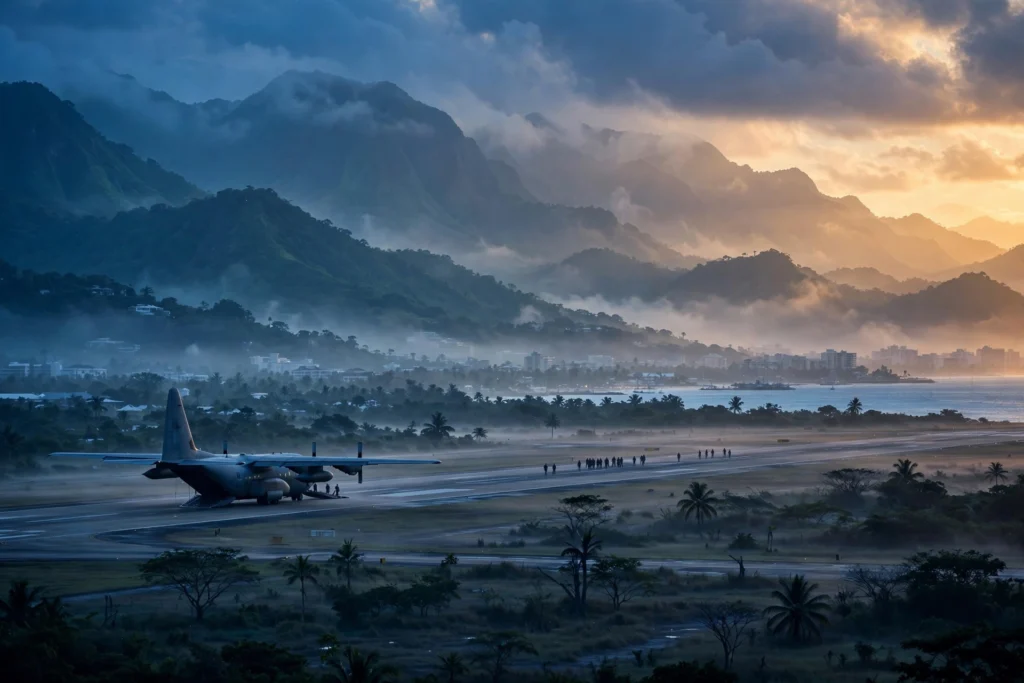
The Trump administration’s involvement has been tangible as well as political. Reuters reported on October 27 that the United States provided C-130 transport aircraft to help move Salvadoran troops to Haiti, citing a United States military official. Additional commercial and military flights between San Salvador and Port-au-Prince were visible on flight-tracking data and were reported by the Miami Herald, and a photograph posted on social media by a lawmaker from Bukele’s ruling party showed a plane carrying uniformed soldiers. In other words, whatever the precise terms of the political backing reported by Axios, American aircraft helped put the Salvadoran force on the ground.
That logistical role sits within a wider pattern of cooperation between Washington and San Salvador under Trump, and the United States launched a US-led anti-crime coalition called Shield of the Americas earlier this year, which Reuters noted in its reporting. Security analysts in El Salvador told Reuters they were cautious about a mission without a formal agreement, United Nations backing, or support from that coalition.
The Ambush That Triggered the Surge
The chain of events began on October 18, when four Salvadoran members of the United Nations-backed security mission went missing in a gang ambush on the outskirts of Port-au-Prince, in an area controlled by gangs. Reuters reported that the four men, described as aircraft technicians, jumped from a burning vehicle during the attack. Bukele later said he believed they were being held hostage by criminal groups, and his government announced a military operation to recover them. The technicians had been returning to base from a market when they were attacked, according to Reuters, a detail that underlines how exposed even routine movements have become in and around the Haitian capital.
No Haitian gang has claimed responsibility for the ambush. Wilson Joseph, the leader of the 400 Mawozo gang, released videos denying that his group was holding the Salvadorans or was involved in the attack, Reuters reported. Bukele billed the deployment as a rescue mission, and a CID Gallup poll on Wednesday showed 86 percent of Salvadorans approved of the Haiti mission, even as 82 percent also expressed concern for their countrymen, according to Reuters.
Haiti’s Gang Crisis and the UN-Backed Force
Haiti’s gang crisis did not begin with the October ambush, and the Salvadoran deployment cannot be understood without the longer history behind it. Haiti’s unelected leaders have since 2022 called for international forces to help fight heavily armed gangs, Reuters reported, and the country has lived for years with violence that has overwhelmed its own police and hollowed out basic services. The United Nations-backed Gang Suppression Force was the international answer to those appeals, but it has struggled. Reuters reported that the force had reached only about 2,000 personnel, just over a third of its planned strength, a year into its mandate, with little improvement in Haiti’s security.
Sam Vigersky, a policy expert at the Council on Foreign Relations, told Reuters that the United Nations-backed mission, renewed for just six months in September, was under pressure to produce results, but that the Salvadorans’ arrival signalled more chaos. Pierre Esperance, head of Haiti’s National Human Rights Defense Network, welcomed the unusually rapid Salvadoran deployment, according to Reuters.
Haiti has also hired a private military company run by Erik Prince, the founder of Blackwater and an ally of Trump, to fight the gangs, Reuters reported. That company has since 2025 carried out controversial anti-gang drone operations, yet gangs have nonetheless continued to make gains. Luis Contreras, a Salvadoran security and organised crime analyst, told Reuters he expected that at least some of the new troops would operate outside the United Nations-backed mission’s chain of command and could coordinate with Prince’s firm. That expectation, if borne out, would blur the boundary between a state-led rescue operation, an international mission and a private security campaign, and it would make accountability harder to trace.
What Is Still Unclear: Command, Rules and Duration
For all the reporting on troop numbers and flights, the most important facts about the deployment remain undisclosed. Reuters reported that authorities had not clarified the troops’ command or their rules of engagement, and that the lack of clarity was fuelling concerns about more risks to civilians in a country with a long history of harmful foreign interventions. That history matters. Haiti has experienced foreign interventions that promised security and delivered abuses, and human rights advocates are therefore right to ask, before a new force becomes entrenched, who gives its orders, what force it may use, how it will distinguish gang fighters from civilians in areas where gangs live among the population, and what happens if its members are accused of wrongdoing.
Duration is equally uncertain. Bukele said the deployments were nearly finished, but finishing a deployment is not the same as finishing a mission. If the four technicians are found alive, will the troops withdraw, or will they stay to support the wider fight against gangs? If they are not found, will the force expand beyond the reported cap of 2,500, or will it be withdrawn after a defined period? If the troops take casualties, or if they clash with gangs in Port-au-Prince, will the operation escalate? None of those questions has a public answer, and each of them will shape how the deployment is judged in the weeks ahead.
Reactions in El Salvador and Haiti
In El Salvador, the mission has been presented as an extension of Bukele’s domestic success against gangs, and the polling reported by Reuters suggests that presentation has landed. Bukele won huge popularity at home with tough-on-crime policies, including a gang crackdown that relied heavily on mass incarceration, and his supporters see the Haiti deployment as proof that the Salvadoran model can work abroad. Critics, by contrast, worry that a model built on sweeping arrests and emergency powers at home does not translate neatly to a foreign country where the government asking for help is unelected, the gangs are heavily armed, and the international legal framework is contested.
In Haiti, the reaction has been more mixed, and the reporting reflects that complexity. Esperance’s welcome for the rapid deployment sits alongside the concerns voiced by analysts about command, rules of engagement and civilian risk. That mixture is understandable. Haitians living under gang control have every reason to welcome any force that might restore movement, reopen roads and markets, and reduce the daily threat of kidnapping and extortion. They also have every reason to ask who that force answers to, because they are the people who will live with the consequences if it operates without clear limits.
What Happens Next
The immediate next step is the search for the four missing technicians, and that search will test the stated purpose of the deployment. If they are found alive, both governments will be able to present the mission as a success, even as questions about its future remain. If they are found dead, or if they remain missing, the mission will face a harder test: whether a force sent to rescue four people should remain in Haiti, and on what authority, once that rescue has failed or become impossible to complete.
Beyond the search, the key developments to watch are the ones Reuters flagged as still unclear. Any formal agreement between El Salvador and Haiti, any statement from the United Nations about the troops’ relationship to the Gang Suppression Force, and any clarification of command and rules of engagement would each change the legal and political picture. So would any statement from Washington setting out the extent and duration of American support, and any indication that the reported cap of 2,500 troops is a ceiling, a staging point, or a figure that has already been overtaken by events.
For now, the facts that can be stated with confidence are these. Four Salvadoran technicians disappeared after an ambush near Port-au-Prince on October 18. El Salvador responded by sending thousands of troops to Haiti, reaching around 2,000 by Wednesday night and capped for now at 2,500, with American transport aircraft helping to move them. Bukele says the deployment is nearly complete, that his government is paying 90 percent of the costs, and that the mission is a rescue operation. Axios reports that Trump has backed the surge. What has not been explained is who commands the troops, what rules govern their use of force, how long they will stay, and what happens when the rescue mission meets the much larger and longer war against Haiti’s gangs. Those answers, when they come, will determine whether this deployment is remembered as a rescue, a turning point, or a warning.
Source: Axios