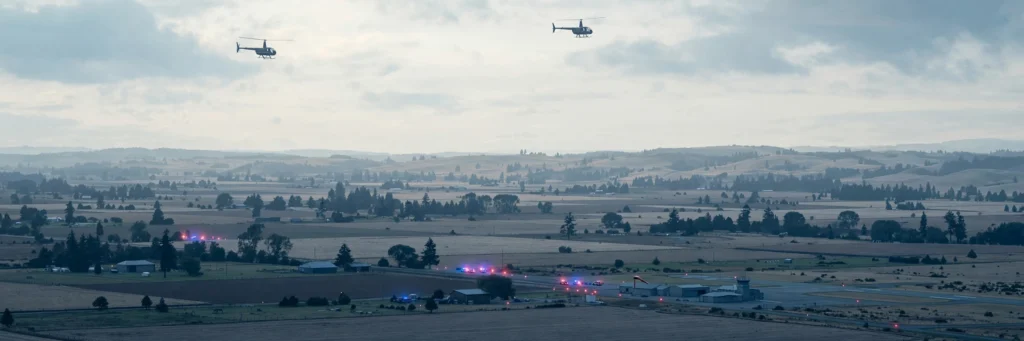
Breaking News: Three Dead in Oregon Helicopter Collision
In breaking news today, three people have died after two helicopters collided in midair near a small airport in northwest Oregon on Thursday afternoon, according to the Yamhill County sheriff. The collision happened near McMinnville Municipal Airport, about 35 to 40 miles southwest of Portland, and sent both aircraft crashing to the ground in a field just outside the airport perimeter. All three people aboard the two helicopters were killed, Sheriff Sam Elliott said at a news conference on Thursday evening, bringing a swift and sombre end to what had begun as an ordinary afternoon of flying in Yamhill County.
The crash was reported at about 2:15 p.m. local time on Thursday, October 29, when emergency crews were called to a field near Southeast Highway 154, also known as Lafayette Highway, and Southeast Stringtown Road, southeast of McMinnville. The Yamhill County Sheriff’s Office responded to the scene along with local law enforcement, fire and medical responders, and the area around the crash site was closed off as rescue workers arrived. A nearby highway was shut down, and the investigation was handed to the federal authorities who examine every fatal aviation accident in the United States.
The sheriff’s evening briefing gave the first confirmed account of who was aboard the two aircraft, although the names of those killed had not been published in the reports checked for this article. One helicopter was carrying two people: a flight instructor from Texas and a student pilot from the United Kingdom. The other helicopter was flown by a single occupant, a man from Newberg, Oregon. The three deaths were confirmed by the sheriff after earlier reports, filed in the first hours after the crash, had said only that the occupants’ conditions were unknown. That gap between the first reports and the evening briefing is common in aviation accidents, where officials wait until families have been informed and facts have been checked before confirming fatalities.
What Happened Near McMinnville Municipal Airport
The Federal Aviation Administration said the collision was between a Robinson R22 helicopter and an Airbus H125 helicopter. Only the pilot was aboard the R22, while two people were aboard the H125, according to the FAA statement. The two aircraft collided in midair a few miles east of McMinnville Municipal Airport, then came down in a private field near the junction of Southeast Highway 154 and Stringtown Road, southeast of the town. A witness told a local television station that he was standing on the roof of a nearby barn when he saw the helicopters strike each other, and that both aircraft then hit the ground just outside the airport perimeter. He said he immediately called 911.
The sheriff’s office said it received reports of the collision at 2:14 p.m. local time, a minute before the time given by the FAA for the crash itself, a small difference that reflects the way emergency calls and official timings are recorded in the first minutes of a major incident. What is not in dispute is the sequence that followed: both helicopters fell to the ground, emergency crews from the McMinnville Fire District and other agencies rushed to the field, and the road network around the site was closed to keep the area clear for responders and, later, for investigators.
One of the helicopters involved in the crash was operated by Jerry Trimble Helicopters, a helicopter flight training school and rental service for private flights, the company said in a statement. The company did not, in the reports checked, specify which of the two aircraft it operated, and the sheriff’s briefing described the two people aboard one helicopter as a flight instructor and a student pilot, a pairing consistent with a training flight. The other helicopter’s sole occupant was described only as a man from Newberg, a town in the same county, about 15 miles northeast of McMinnville. No further details about the flights themselves — where they had departed from, where they were heading, or what phase of flight they were in when they collided — had been released in the reports checked for this article.
Emergency Response and the Highway Closure
The response to the crash involved multiple agencies, as is standard for an aviation accident in a rural area. The Yamhill County Sheriff’s Office coordinated the scene, local law enforcement officers secured the roads, firefighters from the McMinnville Fire District attended, and medical responders were dispatched to the field. The crash site itself was in open farmland, which meant responders could reach the wreckage quickly, but also meant that the investigation would need to secure a wide area around two separate impact points.
The Oregon Department of Transportation closed Highway 233 about one mile west of Dayton, near McMinnville Municipal Airport, because of the crash. Early reports gave the closure in slightly different terms — one report described the closure as 1.6 kilometres west of Dayton, which is the same distance expressed in metric units — but the practical effect was the same: a key local route was shut to traffic, and drivers were warned to use an alternative route. One early official message warned motorists that the closure could be extended, a warning that reflects how long an aviation investigation can keep roads closed while wreckage is documented and removed.
McMinnville itself is a town of about 34,000 people, about 56 kilometres southwest of Portland, and its municipal airport serves general aviation: private flights, flight training and local business flying, rather than scheduled airline services. That character matters for understanding the crash, because the airspace around a general-aviation airport is shared by aircraft of very different sizes and speeds, flown by pilots of very different experience levels, from student pilots on training flights to experienced private pilots. The two aircraft in this collision illustrate that mix: a Robinson R22, a two-seat helicopter widely used for training, and an Airbus H125, a larger single-engine helicopter that can carry up to six passengers depending on its configuration, although only two people were aboard on this occasion.
The Investigation: What the NTSB and FAA Will Do
The investigation into the crash is being led by the National Transportation Safety Board, according to the FAA, which is also probing the incident. That division of labour is the standard arrangement for a fatal civil aviation accident in the United States. The NTSB leads the investigation and determines the probable cause, while the FAA, which regulates aviation and certifies pilots and aircraft, supports the investigation and considers whether any regulatory action is needed. The NTSB said it was aware of the incident and was gathering information, and the FAA confirmed that the board would lead the inquiry.
In the first hours and days of such an investigation, the work is largely about preserving and recording evidence. Investigators document the wreckage where it lies, photograph the impact sites, and record the positions of the two aircraft relative to each other and to the airport. They speak to witnesses, including the man who saw the collision from the roof of a barn, and they gather records: flight plans and radio communications where they exist, maintenance records for both aircraft, and the qualifications and medical certificates of the pilots. For a midair collision, a central question is always what each pilot could see and when, and whether either aircraft was in a position where the other was hidden by the structure of the helicopter, by the sun, or by the background of the ground below.
The NTSB’s findings will emerge in stages. A preliminary report, which typically sets out the basic facts of the accident without assigning a cause, usually follows within weeks, while a final report with a probable cause can take many months. In the meantime, the sheriff’s office, the FAA and the NTSB are the authoritative sources for updates, and the families of those killed will be informed through official channels before further personal details are released. That is why, at the time of writing, the reports identify the occupants only by their roles and home places — a flight instructor from Texas, a student pilot from the United Kingdom, and a man from Newberg — rather than by name.
A Town, an Airport and a Training Community
What Happens Next
In the immediate term, the priorities are the investigation and the road network. The Highway 233 closure west of Dayton had no published estimate for reopening in the early reports, and drivers in the area were advised to use alternative routes until the authorities confirmed the road was clear. The wreckage of both helicopters will need to be removed from the field, and the investigation site will need to be released by the NTSB before normal activity resumes around it.
For the families of the flight instructor from Texas, the student pilot from the United Kingdom and the man from Newberg, the next days will be dominated by the formal processes that follow a fatal accident: identification, notification, and the return of personal effects, followed by funerals far apart in geography but united by a single afternoon in Oregon. For the town of McMinnville, the crash will leave a mark on an airport and a flying community that, like every small aviation community, knows that flying carries risks even when it is carried out carefully and by the book. The investigation will, in time, say more. For now, the story is one of three lives lost in a collision that no one on the ground, and no one in either cockpit, appears to have been able to prevent in the moments before it happened.
Source: KATU