Trump News: Veterans Chief Says He Was Misled on Arch
In the latest trump news, the head of one of America’s largest veterans organisations has told his members that he was misled before his group lent its name to a court brief supporting President Donald Trump’s planned triumphal arch near Arlington National Cemetery. Tom Burke, the president of Vietnam Veterans of America, said in an email to members on Thursday that he had been given inaccurate information before the organisation joined the brief, and that the document went further than he had anticipated or intended. The admission, reported by The Washington Post, has thrown the veterans groups’ position on the arch into confusion only a day before a federal judge is due to hear arguments about whether construction of the 250-foot monument can proceed.
Burke’s message was blunt about the organisation’s formal position, even as it left open the question of how the brief came to be filed in its name. “Let me be clear: National VVA has not adopted a position supporting or opposing construction of the proposed arch or its design,” he wrote, according to the email shared with the Post. He also acknowledged the frustration of members who oppose the project, a frustration that has been visible inside the organisation since the brief was filed. The email did not identify who provided the inaccurate information, nor did it specify what that information was, leaving the central question of the episode — how a group that had publicly declared neutrality came to sign a brief urging a judge to let the arch be built — still unanswered.
What Burke Told Members on Thursday
Burke’s email arrived on Thursday, a day after the brief was filed and a day before the court hearing. According to the Post’s reporting, he told members that he was given “inaccurate information” and that the pro-arch legal brief filed by his organisation and several other veterans groups “went further than I anticipated or intended.” The wording is careful. It does not say that he never agreed to join a brief at all, and it does not say that he was unaware a brief was being prepared. What it does say is that the document as filed went beyond what he expected, and that the national organisation has not taken a position for or against the arch or its design.
The Brief That Broke the Neutrality Pledge
The sequence of events over the past few days is what makes Burke’s email so striking. On Tuesday, Burke told the Post that his group and three others planned to stay neutral on the arch, and that he was not aware of plans to join a legal brief. He also shared a written statement from the four groups saying they did not “endorse or oppose any specific architectural design or proposal” and calling for Americans to unite around a new monument honouring veterans in Memorial Circle, the traffic circle at the western end of Arlington Memorial Bridge where the arch would stand.
Hours later, that neutrality statement was overtaken by events. Several veterans groups, including Vietnam Veterans of America, Veterans for America First and other associations, joined a brief filed with the court that called for construction to begin soon on the arch. The brief also argued that the three Vietnam War veterans suing to stop the project had no grounds to oppose it. The contrast between the Tuesday statement and the brief that followed could hardly have been sharper, and it is that contrast that has driven the criticism since.
According to three people familiar with the plans, who spoke on the condition of anonymity because they were not authorised to discuss the matter publicly, the White House encouraged the groups to sign the brief. The White House did not respond to questions on Tuesday about the planned brief, and spokespeople for the White House and for Consovoy McCarthy, the conservative law firm that handled the brief, did not respond to questions on Thursday either, according to the Post’s reporting. The involvement of the White House, if confirmed in fuller detail, would explain how groups that had declared neutrality came to file a brief within hours of that declaration, but it would not by itself explain the contents of the brief or the claim it made about member support.
A Split Inside the Korean War Veterans Association
The same pattern appears to have played out at another organisation that signed the brief. David Pickett, who served as president of the Korean War Veterans Association until June and remains on its board, said on Thursday morning that he opposed his organisation’s decision to endorse the arch because the topic had not been discussed by the group’s leaders or members. His account suggests that the endorsement was not the product of a deliberative process inside the association, but a decision taken without the discussion that members might reasonably have expected on a question of this significance.
Harold Trieber, the current president of the Korean War Veterans Association, subsequently told the Post that he had made the decision for his group to endorse the arch. His account, as reported, was strikingly direct: he represents the association, and he did not think the question should be polled among members. That position raises a different question from the one Burke’s email raises. Burke says he was given inaccurate information and that the brief went further than he intended. Trieber says he decided on his own. Both accounts point to the same underlying problem, which is that the brief presented itself as the voice of veterans organisations without, in these cases, the internal discussion or agreement that would normally give such a voice its authority.
The Arch, the Cemetery and the Court Case
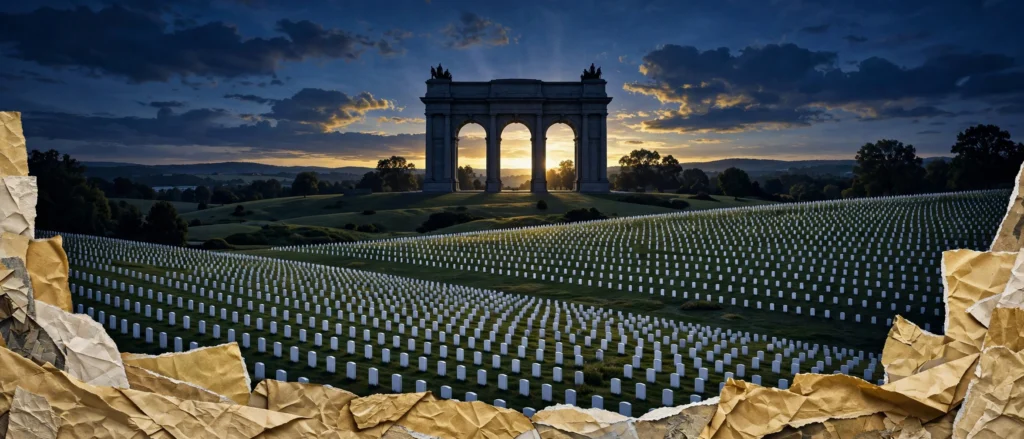
The monument at the centre of the dispute is a planned 250-foot triumphal arch near Arlington National Cemetery, which the president has identified as a priority to mark the nation’s 250th anniversary this year. The administration hopes to begin construction on November 5, according to the reporting, a timetable that gives the court case its urgency. The arch would stand in Memorial Circle, at the western end of Arlington Memorial Bridge, beside one of the most visited and most solemn sites in the country.
The legal challenge comes from three Vietnam War veterans who say the arch would disrupt the experience of visiting the cemetery and interfere with the intent of nearby monuments. Their case is being heard by United States District Judge Tanya S. Chutkan, who is due to hear arguments on Friday on whether construction can proceed. The judge, an appointee of President Barack Obama, has been weighing whether to let the arch move forward while the lawsuit is pending, and the brief filed by the veterans groups was part of the material before her.
White House News and the Politics of Endorsement
In white house news terms, the episode is a reminder of how much weight the administration places on endorsements from veterans groups, and how quickly such endorsements can unravel when they are not backed by the organisations they claim to represent. The White House encouraged the groups to sign the brief, according to the three people familiar with the plans cited by the Post, and the brief was filed by a conservative law firm with close ties to the administration’s legal world. The combination of White House encouragement, a swift filing and a claim of broad member support gave the brief an appearance of consensus that the subsequent accounts from Burke, Kalner, Pickett and Trieber have now called into question.
Reactions and What Happens Next
Reaction to Burke’s email has so far come mainly from inside the veterans community, where chapter and state leaders have said they were not consulted and where members opposed to the arch have welcomed the restatement of neutrality. The broader political reaction is likely to follow the court hearing on Friday, when Judge Chutkan hears arguments on whether construction can proceed. That hearing will be the first test of whether Burke’s email changes the legal picture. The brief itself remains filed with the court, and the judge will have to decide how much weight to give it in light of the national president’s statement that his organisation has taken no position.
The administration’s timetable adds pressure to that decision. With construction hoped to begin on November 5, a ruling that allows work to start would set the project in motion quickly, while a ruling that blocks or delays it would leave the arch in limbo. Either way, the lawsuit brought by the three Vietnam War veterans will continue, and the question of whether the arch degrades the experience of visiting Arlington National Cemetery will remain before the courts.
The arch itself, meanwhile, remains a project defined by its scale and its setting. A 250-foot monument beside Arlington National Cemetery was always going to divide opinion, and the division among veterans is real, not manufactured. What Burke’s email has changed is the claim that the division runs only one way, with a broad veterans consensus behind the arch and only a small minority opposed. On the evidence now available, the veterans community is split, its national organisations are divided, and the court will have to weigh the arch on its merits rather than on the strength of a consensus that, by the account of one of its supposed authors, never existed.
Source: The Washington Post