Trump Rally Stabbing Claim Denied by Ohio Police
Police in Chillicothe, Ohio, have denied that anyone was stabbed outside a trump rally held by President Donald Trump on Wednesday night, saying a widely shared video was misread in the hours after the event. The denial, issued on Thursday, directly contradicted claims that had spread across social media while the president was still speaking inside the venue. According to the police account, the object that looked like a knife sticking out of a man’s back was an officer’s own pocketknife, which had become caught on the man’s clothing when the officer stepped in to break up a fight. The knife, police said, never opened.
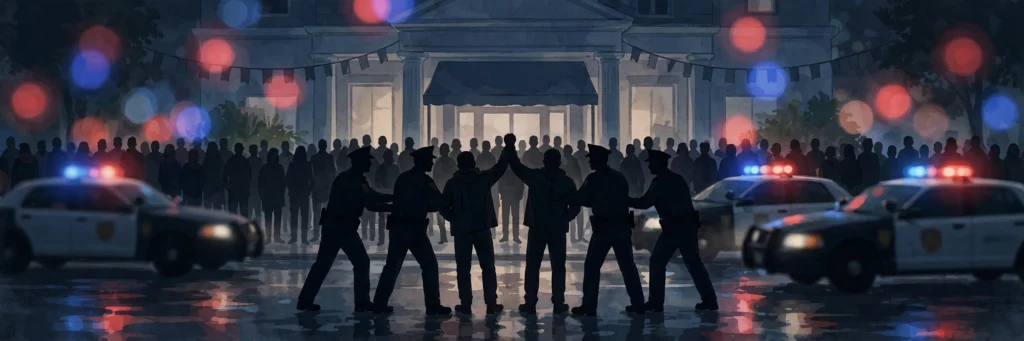
The episode began as a confrontation outside the Shoemaker Center on the Ohio University Chillicothe campus, where Trump was addressing supporters at a midterm campaign event. Video recorded outside the building showed a man sitting on a curb with what appeared to be a small knife with an orange handle protruding from the left side of his lower back. The clip travelled quickly online, and early reports, based on the footage and on accounts from people at the scene, described the incident as a stabbing. One person was detained at the scene as officers responded to the disturbance.
By Thursday morning, the Chillicothe Police Department was pushing back on that description in clear terms. Captain Michael Short told news outlets that there had been no stabbing at all. The incident, he said, involved a fight between two people, and an officer who intervened to separate them was the source of the knife seen in the video. The retention clip that held the officer’s pocketknife in place, Short explained, became snagged on one of the men’s shirts during the struggle. Because the knife itself stayed closed, the man was not cut by it, even though the handle and clip were visible against his clothing in the footage.
That explanation matters because it changes the story from an act of violence against a rallygoer into an accident during a police intervention. The distinction was not visible in the first clips, which showed only the aftermath: a man on a curb, an object that looked like a blade, and officers moving quickly around him. Viewers who saw the video without the police explanation had little reason, at first glance, to doubt that a stabbing had taken place. The police statement was therefore not a minor correction. It reversed the central claim of the night’s most shared piece of footage from the rally.
Trump Rally: The Fight Outside the Shoemaker Center
The trump rally itself was a familiar closing-week campaign stop. Trump was in Chillicothe to support the Republican ticket in Ohio, including Senator Jon Husted, who is defending his Senate seat, and Vivek Ramaswamy, the Republican candidate for governor. The visit was Trump’s third stop in Ohio during the midterm campaign, following earlier appearances in the Dayton area and in Youngstown, and it came as both parties poured their most prominent figures into the final days before Election Day.
Security for the event was led by the United States Secret Service, with support from local and regional law enforcement, a standard arrangement for a presidential visit. Inside the Shoemaker Center, protesters had been removed from the venue earlier in the evening, and a small group of demonstrators had gathered outside during the day. The confrontation that produced the viral video happened outside the building while Trump was speaking inside, in the crowded, tense atmosphere that often surrounds a presidential rally in its final hours.
What exactly started the fight has not been fully explained in the reports published so far. The initial local report, published late on Wednesday night, said further details about the man in the video, the identity of the person detained, any charges, and a possible motive were not immediately available.
The sequence is worth setting out plainly, because the order in which information reached the public shaped everything that followed. First came the video, filmed outside the venue on Wednesday night and posted online while the rally was under way. Then came the early news reports, which repeated what the video appeared to show and what witnesses at the scene believed they had seen. Only later, on Thursday, came the police statement, which offered a different and much less alarming account of the same images. By then, the stabbing claim had already travelled far beyond Chillicothe, carried by social media posts and by commentators who treated it as evidence of political violence.
Midterm Elections 2026: How a Viral Clip Outran the Facts
The midterm elections 2026 have been fought in an atmosphere in which a single clip can define a night before any official account exists. Campaigns now unfold simultaneously on stage and on phones, and the audience for a rally is no longer limited to the people inside the hall. A video shot outside a venue in a small Ohio city can reach a national audience within minutes, and it can be shared, captioned and reinterpreted thousands of times before police, campaign staff or journalists have had time to check what actually happened.
That dynamic was on full display on Wednesday night. The footage from Chillicothe was dramatic and easy to misread: a man sitting down, an object that looked like a knife, officers rushing in, and a person being detained nearby. Each of those elements, on its own, pointed toward a violent attack. Together, they made a compelling story, and several social media posts presented the incident as a deliberate stabbing of a Trump supporter by an opponent of the president. One prominent campaign figure shared the video with exactly that framing, describing the episode as political violence and urging prayers for the man in the footage.
The police account, when it arrived, did not merely add context to that story. It contradicted its premise. If the knife belonged to an officer, never opened, and became caught on clothing during an intervention, then there was no attacker with a knife and no victim of a stabbing. The detained person, whose detention had been cited in early reports as further evidence of an attack, was detained in connection with the fight itself, not, on the police account, as a suspected stabber. The correction therefore mattered not only for accuracy about one night in Ohio, but for the wider argument that had already been built on top of the claim.
This is a pattern that has become familiar in the final week of a hard-fought campaign. Claims about violence, intimidation or disorder at campaign events carry particular weight because they feed directly into the arguments each side is making about the other.
Swing States and the Final Week: Why Ohio Matters
Ohio has been one of the most closely watched swing states in the closing days of the campaign, and that is part of why a disturbance outside a rally there drew national attention so quickly. The state has voted Republican in recent presidential elections, but its Senate and governor’s races have tightened in the final weeks, and both parties have treated Ohio as a test of whether the president’s personal campaigning can steady a ticket under pressure.
Husted is defending a Senate seat against former Democratic Senator Sherrod Brown, who is attempting a comeback two years after losing re-election. The governor’s race, between Ramaswamy and Democrat Amy Acton, has drawn national attention of its own, in part because of a controversial campaign advertisement that divided Ohio Republicans and shifted assessments of the race. Trump’s presence in Chillicothe, in Ross County, a county he has carried three times, was designed to energise the voters his party most needs to turn out in a midterm election, when turnout itself can decide close races.
The timing amplified the stakes. With Election Day on November 3 less than a week away and early voting already under way in many states, both parties have deployed their biggest names to the places where turnout could decide control of Congress. Trump has spent the closing stretch touring states he carried comfortably, trying to lift Republican candidates in tight races, while former President Barack Obama has campaigned for Democrats in states including Ohio and Georgia. On Wednesday night, the two schedules collided, with Trump in Ohio and Obama in Georgia, each framing the election as a verdict on the president himself.
In that context, an incident outside a rally is never just a local disturbance. It becomes, almost immediately, a symbol in a national argument.
What Happens Next: The Police Account and the Campaign
What happens next will be determined, in the first instance, by whether the Chillicothe Police Department issues any further statement. The denial published on Thursday answered the central question, but it left open the details that usually follow a disturbance at a major campaign event: the precise sequence of the fight, the identities of the people involved, and whether anyone will face charges arising from the altercation. Those details, if they are released, will come from the department or from court records, not from social media, and they will be the test of whether the Thursday account holds up in full.
The wider campaign, meanwhile, moves on quickly. There are only days left before voters decide the midterm elections, and both parties will spend them in the same places, making the same closing arguments. Trump will continue to campaign as though his own name were on the ballot, urging supporters to treat the midterms as a referendum on his presidency. Democrats will continue to argue that the election is a chance to check a presidency they describe as chaotic and damaging. Neither side is likely to dwell on Chillicothe, except as a cautionary example — for one side, of political violence, and for the other, of how quickly an unconfirmed claim can harden into a story.
For voters, the lesson of the episode is practical rather than partisan. A video, however vivid, is not a complete account of an event. The object that looks like a knife may be a knife that never opened. The person detained at a scene may not be the person who committed the act that viewers assume took place.
Source: The National Desk