Trump News: Veterans Groups Split Over Arch Plan
In the latest Trump news, several veterans groups have declared neutrality on President Donald Trump’s proposed triumphal arch, breaking from other veterans and advocacy groups that have said the towering structure will harm the experience of visiting nearby Arlington National Cemetery. The Vietnam Veterans of America and three other associations said in a statement shared with The Washington Post that they would take no position on the design, distancing themselves from efforts by other veterans to halt construction of the 250-foot monument in Memorial Circle. The groups called for Americans to unify around the prospect of a new monument to honor veterans built in the traffic circle at the western end of Arlington Memorial Bridge. The move exposes a split inside the veterans community over one of the president’s most controversial building projects, and it comes as a federal judge weighs whether to let the arch move forward and as a review panel prepares to consider its final plans.
The statement was carefully worded. “Our organizations … do not write to endorse or oppose any specific architectural design or proposal,” the groups said, a formulation that keeps them out of the fight without endorsing the arch itself. The neutrality declaration matters because the opposition to the arch has been led in large part by veterans, whose voices carry special weight in a dispute about a monument that would stand beside the nation’s most hallowed military cemetery. By stepping aside, the four associations deprive the opposition of some of its most credible spokespeople, even as other veterans continue to fight the project in court and in public.
Trump News: A Movement Divided
The division is not only between organizations but within them. Jay Kalner, the president of the Vietnam Veterans of America’s Northern Virginia chapter, told The Washington Post on Tuesday that he and other local leaders of the group oppose the arch, a position that sits uneasily with the national organization’s declaration of neutrality. The split reflects a broader disagreement among veterans about what the monument means. For some, a grand arch honoring the nation’s veterans is a fitting tribute, a landmark worthy of the sacrifices it commemorates. For others, a 250-foot structure looming over the graves at Arlington is an intrusion, a monument to the president who ordered it rather than to the service members buried nearby.
The opposition has been organized and vocal. VoteVets, a political organization aligned with Democratic veterans, launched a campaign last month to mobilize more veterans against the planned arch, arguing that the structure would overshadow the cemetery and diminish the experience of visiting it. The symbolism of the arch casting its shadow over graves has drawn rebukes from veterans groups and from the families of the fallen, and it has become the central image of the opposition’s case. The arch’s supporters answer that the monument would honor veterans, not overshadow them, and that a new landmark in Memorial Circle would give Americans a place to reflect on the nation’s history. The neutrality statement from the Vietnam Veterans of America and its partners lands between those two positions, declining to take a side while calling for unity around the idea of a monument.
The fight over the arch is also a fight over who speaks for veterans. The groups that oppose the project argue that their service gives them a special standing to judge what belongs beside Arlington. The groups that have declared neutrality argue that veterans are not of one mind, and that no single organization should claim to speak for all of them. The statement shared with The Washington Post makes that point implicitly: four associations, including one of the largest veterans organizations in the country, are unwilling to join the campaign to stop the arch, even as other veterans press ahead with it.
White House News: The Arch and the Shadow Study
The monument at the center of the dispute would stand about 250 feet tall, including the statue at its highest point, in Memorial Circle, the traffic circle across the Potomac River from the Lincoln Memorial and beside Arlington National Cemetery. Trump has proposed the structure as a celebration of the accomplishments of the American people, and it has become one of the signature projects of his second-term building program in the capital, alongside the new White House ballroom, the redesign of the Rose Garden, and the renovation of the Kennedy Center. A minority staff estimate from the Joint Economic Committee put the cost of the arch at 100 million dollars, part of a building program it tallied at more than 1.8 billion dollars including private spending.
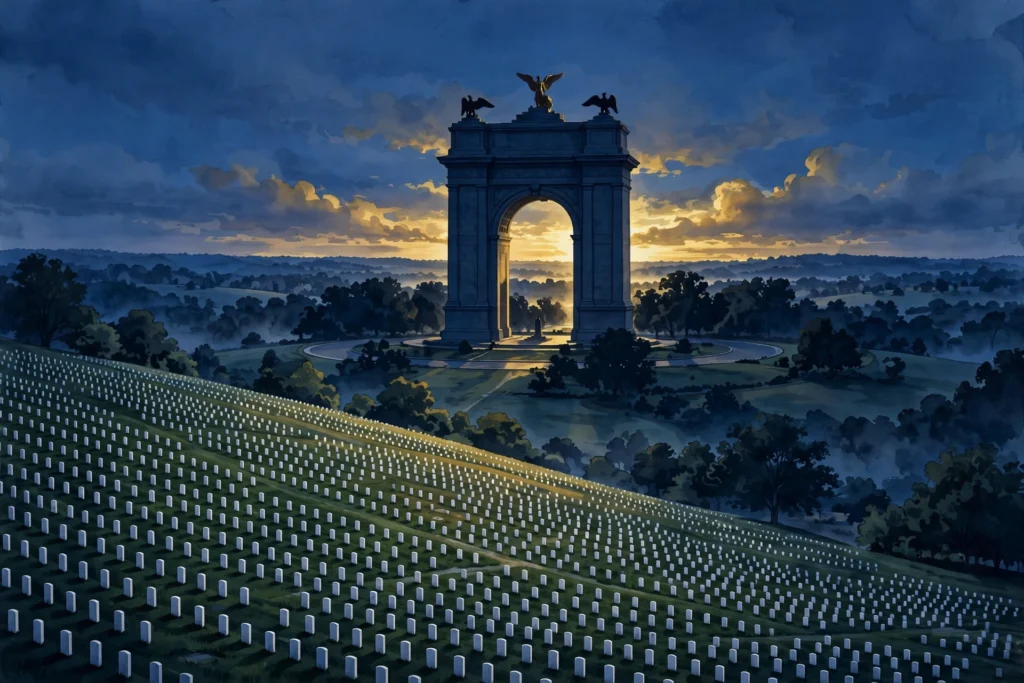
The Post on Tuesday published an analysis of how the arch’s shadows would move across the graves of veterans and their next of kin, based on a three-dimensional model of the structure. According to the analysis, the shadows would fall across burial sections holding veterans of the Vietnam War, the Korean War, World War II, World War I, the Spanish-American War, and the Civil War. The finding gave the opposition a vivid and specific complaint: not merely that the arch would be large, but that its shadow would pass over the graves of the dead. The administration has disputed the significance of the shadow, saying only a small portion of the cemetery would be affected and only briefly, but the image of a monument’s shadow crossing headstones has proved difficult to answer.
Public opinion is divided. A September YouGov poll found that 48 percent of Americans oppose the arch, and 30 percent support the project, with the remaining 22 percent unsure. The numbers suggest that the president’s monument is unpopular but not overwhelmingly so, and that a substantial share of the public has not made up its mind. The poll also suggests that the debate is far from settled, and that the court case and the review process may do more to decide the arch’s fate than public opinion will.
Trump Administration: The Court Fight and the November 5 Date
The legal fight over the arch is now before U.S. District Judge Tanya S. Chutkan, an appointee of President Barack Obama, who is weighing whether to let the project move forward. Three Vietnam War veterans, Michael Lemmon, Shaun Byrnes, and Jon Gundersen, joined retired architectural historian Calder Loth in filing a lawsuit earlier this year arguing that the arch would disrupt the experience of visiting the cemetery and interfere with the intent of nearby monuments. They also argue that the administration lacks the legal authority to proceed without congressional authorization. On October 22, the plaintiffs asked Chutkan to block construction while the legal challenge remains pending, seeking a preliminary injunction that would preserve the status quo until the case is decided. They have asked for a ruling by November 4.
The timing matters because the project may move quickly. A federal review panel, which Trump has stocked with allies, is expected to approve the arch as early as November 5, when the National Capital Planning Commission is scheduled to consider the project’s final plans. Administration officials hope to begin work immediately afterward. If the commission approves the plans and the remaining government requirements are completed, construction could begin that same day, turning a contested proposal into a physical project before the courts have finished weighing it. The plaintiffs’ injunction request is designed to prevent exactly that, freezing the project in place while the litigation continues.
Arlington County has filed a separate lawsuit challenging the approval process and raising concerns about transportation, public safety, and environmental impacts. The county’s case, filed in federal court in Virginia, argues that the administration bypassed standard review procedures in its haste to advance the project. The administration has denied those claims and maintains that the project is proceeding through the required federal reviews. The two lawsuits together mean the arch faces legal challenges on two fronts, even as the review panel moves toward approval.
What Happens Next: Monument or Lawsuit
The next ten days will decide whether the arch moves from paper to ground. If Judge Chutkan grants the injunction by November 4, construction will be barred while the case proceeds, and the November 5 review will become a formality rather than a starting gun. If she declines, and the planning commission approves the final plans, work could begin immediately, and the opposition’s remaining hope would be a ruling on the merits months from now, by which time the arch could already be rising. The neutrality declaration from the veterans groups adds a political dimension to that legal timetable, suggesting that the opposition’s coalition is fraying just as the decisive moment arrives.
The broader question is what the arch will mean if it is built. Supporters present it as a monument to the American people and their accomplishments, a landmark for a nation approaching its 250th anniversary. Critics present it as a monument to a president’s vanity, a structure that would dominate a landscape of memory and sacrifice. The veterans groups that have declared neutrality have chosen not to answer that question, calling instead for Americans to unify around the prospect of a new monument to honor veterans. Whether that unity is possible, with a court case pending and a construction date days away, will become clear in the first week of November.
Source: The Washington Post