Apple News: Touchscreen MacBook Pro Coming October 28
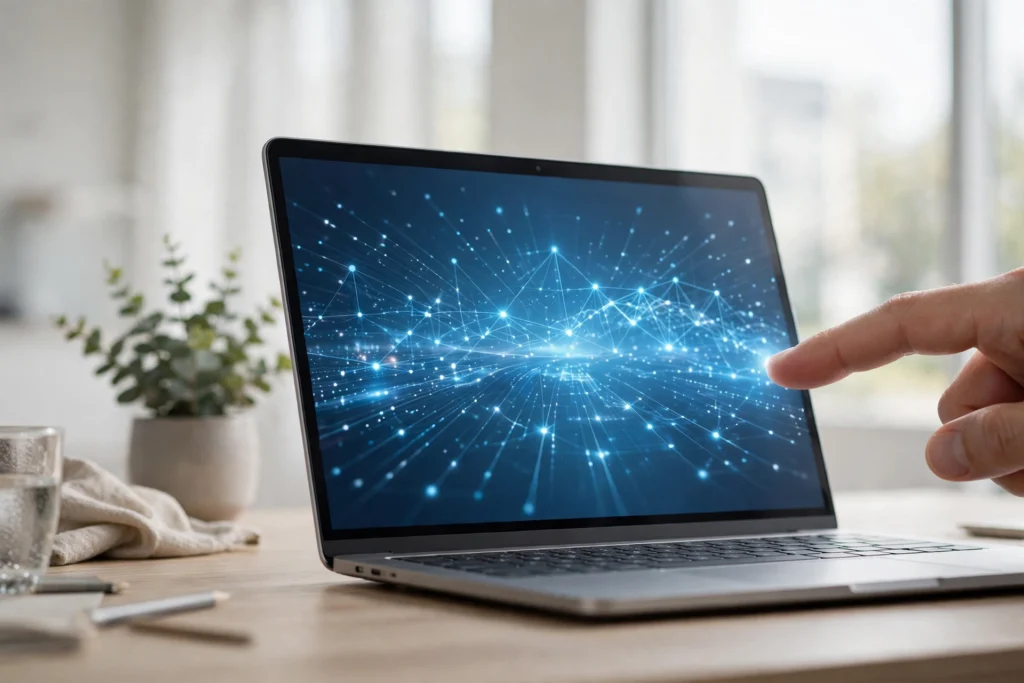
Apple is about to do the thing it has spent the better part of two decades saying it would never do. According to Bloomberg’s Mark Gurman, the Apple news this week is that the company plans to unveil MacBook Pro models with touch-enabled OLED displays on Wednesday, October 28 — the first Mac with a touchscreen, and the end of one of the longest-running refusals in consumer technology. The announcement is expected to come by press release, followed by hands-on time for invited guests at an Apple experience in Los Angeles, and it would arrive almost exactly sixteen years after Steve Jobs dismissed the very idea of a touch-screen Mac as ergonomically absurd.
Apple has been rolling out new products in waves through October, and the touchscreen MacBook Pro would be the most consequential of them — not because of raw speed, but because it reverses a position the company has defended since the iPhone remade its business. For years, Apple insisted that touch belonged on phones and tablets while the Mac stayed loyal to the keyboard and trackpad. On Wednesday, if Gurman’s reporting holds, that line disappears.
What makes the timing striking is how long the idea has been in the open. Rumours of an OLED MacBook with touch have circulated for years, gathering pace through 2026 as Bloomberg reported on Apple’s plans in successive newsletters and podcasts. Each time, the question was not whether the technology existed — Windows laptops have offered touchscreens for more than a decade — but whether Apple would ever accept it on a Mac. The October 28 date suggests the answer is finally yes.
Apple News: The Touchscreen MacBook Pro Arrives at Last
The centrepiece of Wednesday’s unveiling, according to Gurman, will be 14-inch and 16-inch MacBook Pro models with touch-enabled OLED displays. Apple event news has pointed to October 28 for weeks, and the event itself carries the tagline “Pro and tell” and begins at 10 a.m. Pacific Time in Los Angeles, where invited guests are expected to get hands-on time with the new machines after the announcement. Apple has not said which products it will show, and the company has not commented on any of the reports — but the invitation’s wording, combined with Gurman’s reporting, points squarely at the MacBook Pro.
The timing fits a pattern Apple has followed all month. In tech news, October has been crowded: earlier in the month, the company debuted a new smart home hub, a revamped Apple TV 4K and a refreshed HomePod mini, and Bloomberg has reported that Apple planned two rounds of product launches during October. The second round was originally expected on or around October 27, before the Los Angeles event settled the date at October 28. In iPhone news, the new Duo reached customers on October 23, and the new Apple TV 4K is scheduled for November 13 — a crowded calendar into which the touchscreen MacBook Pro would land as the headline act.
Gurman has also reported that the new models could reach stores on Friday, November 6, following a major reset of Apple retail store floors on the evening of November 5.
What to Expect: OLED, Dynamic Island and a Lighter Frame
The new machines are expected to look familiar at first glance. Gurman reports that the 14-inch and 16-inch models will resemble the current MacBook Pro in overall design, but weigh less, with a Dynamic Island replacing the notch at the top of the screen. The Dynamic Island — the pill-shaped cutout Apple introduced on the iPhone 14 Pro in 2022 and has since spread across its phone line-up — would house the camera and sensors while freeing up more of the display. It is a small visual change with a large symbolic one: the notch, a defining feature of the modern MacBook Pro, would be gone.
Under the screen, the bigger change is the display itself. The new models will use OLED panels, which produce deeper blacks and richer contrast than the mini-LED displays in the current MacBook Pro, and which are also more expensive — a cost that is expected to show up in the price. The semiconductor chip news is less dramatic: Gurman has previously reported that the laptops will be powered by Apple’s existing M5 Pro and M5 Max chips, the processors released back in March, rather than waiting for a new generation of silicon. That decision keeps the focus of the launch on the screen and the touch experience rather than on performance gains, and it fits with reports that Apple is skipping the M6 Pro and M6 Max entirely, moving straight from the M5 to the M7 for its high-end laptop chips. The M7 versions of the touchscreen MacBook Pro are already in advanced testing, according to Gurman’s sources, and could arrive by the end of 2027.
macOS Golden Gate: Touch That Adapts to How You Work
The hardware is only half the story. The new MacBook Pro will run a version of macOS, codenamed Golden Gate, that Gurman describes as featuring a “dynamic interface” for touch input — software designed to change its behaviour depending on how the machine is being used. “The system will take previous interactions into account, presenting controls based on whether someone has been touching the display or using the trackpad,” Gurman wrote. Touching a button, he added, can also bring up a menu around the user’s finger, while the Dock and Menu Bar have been optimised for touch.
The approach matters because it answers the objection Apple has raised for years: that a vertical touchscreen is awkward to use for long stretches. Rather than forcing users to choose between touch and the trackpad, macOS Golden Gate appears designed to let both coexist, surfacing touch-friendly controls when a finger is on the screen and trackpad-oriented ones when it is not. Apple will position touch as an additional input method that customers can use when it makes sense, alongside the keyboard and trackpad, Gurman reported — a framing that echoes how the company introduced the Apple Pencil on the iPad, as an option rather than a replacement.
The Price of Touch: What the New Models Could Cost
The OLED display is expected to make the new MacBook Pro models more expensive. In the United States, pricing for the existing models with mini-LED displays and M5 Pro and M5 Max chips starts at $2,499 for the 14-inch model and at $2,999 for the 16-inch model, and Gurman reports that starting prices for the new models could be up to $500 higher. That would put the entry point for a touchscreen MacBook Pro at roughly $2,999 for the 14-inch and $3,499 for the 16-inch — firmly in the territory of a premium professional machine, and a meaningful premium over the current line.
The existing MacBook Pro models with mini-LED displays will remain part of Apple’s lineup for now, Gurman added, but they will eventually be discontinued. That gives buyers a choice, at least for a while: the familiar, cheaper mini-LED machine, or the pricier OLED model with touch. It also gives Apple a way to manage the transition, keeping a lower-priced option on sale while the new models find their audience. Pricing for the UK and the European Union has not been reported.
The price rise is not surprising. OLED panels cost more than mini-LED, touch layers add further expense, and Apple has never been shy about charging for its flagship hardware. But the size of the increase — up to $500 at the starting level — raises the stakes for the launch. At close to $3,000, the touchscreen MacBook Pro will need to convince buyers that touch on a Mac is worth paying for, not merely a novelty. The hands-on reviews that follow Wednesday’s event will be the first verdict on that question.
Two Decades of “No”: Why Apple Resisted Touch on the Mac
The reason this launch matters beyond its specifications is the history it overturns. In 2010, Steve Jobs argued that “touch surfaces don’t want to be vertical,” contending that reaching up to touch a screen would tire the arm and feel unnatural. His successor, Tim Cook, was blunter still, comparing the idea of combining a tablet and a laptop to merging a toaster and a refrigerator. The company even tried a compromise — the Touch Bar, a touch-sensitive strip above the keyboard — and abandoned it after the feature failed to gain traction with users.
The resistance was never really about the technology. Windows PC makers have sold touchscreen laptops for more than a decade, and Apple itself has shipped touchscreens on every iPhone and iPad since 2007. The objection was philosophical: Apple believed the Mac and the iPad were different tools for different jobs, and that blurring them would weaken both. Touch on a Mac, in that view, was not an innovation but a confusion — a feature borrowed from a different product line that would make the Mac worse at being a Mac.
What changed is harder to say, and Apple has not explained itself. Part of it may be competitive: touchscreens are now standard on premium Windows laptops, and the absence of touch on the Mac had become a talking point in reviews. Part of it may be that the iPad and the Mac have grown closer over the years, with the iPad gaining a keyboard and trackpad and the Mac gaining Apple silicon that shares its architecture with the iPhone. And part of it may simply be that the technology has matured — OLED displays, reinforced hinges and screen hardware designed to prevent the display from wobbling when touched, and software that adapts to the input method, all of which address the practical complaints that once made touch on a laptop feel like a compromise.
What Happens Next: Launch Day and the Wider Lineup
Wednesday’s event will answer the questions that the technology news cycle has been asking for months. The exact prices, the precise launch date, the configuration options and the availability of the new models will all be confirmed — or corrected — when Apple takes the stage in Los Angeles. The hands-on sessions that follow will show whether the dynamic interface in macOS Golden Gate feels like a genuine rethinking of the Mac or a layer of touch bolted onto a system designed for a mouse. And the first reviews will test whether the OLED display, the Dynamic Island and the lighter frame add up to a machine worth the premium.
For the Mac itself, the stakes are longer-term. If the touchscreen MacBook Pro sells, touch will become a permanent part of the Mac, and future models — including the M7 versions already in testing — will build on it. If it does not, Apple will have spent years of engineering on a feature its customers did not want. Either way, Wednesday marks the moment Apple stopped saying no. After two decades of resistance, the touchscreen Mac is here — and the only question left is whether anyone wanted it all along.
Source: Bloomberg