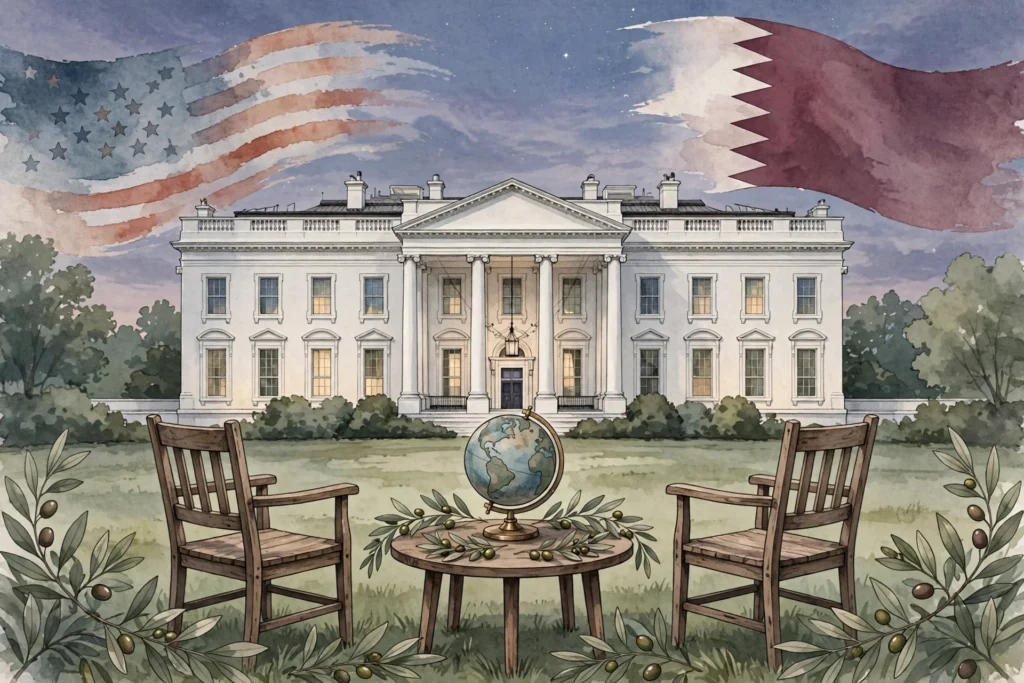
Trump News: Qatar PM Meeting as Iran Talks Stall
Trump news out of Washington on Monday centers on a closed-door meeting at the White House, where President Donald Trump is due to sit down with Qatar’s prime minister, Sheikh Mohammed bin Abdulrahman Al-Thani, as diplomatic efforts to end the war in Iran run into serious difficulty. The meeting, listed on the White House schedule for Monday, November 9, puts the small Gulf state that has acted as the main go-between for Washington and Tehran back at the center of the diplomacy, at a moment when the talks it has been carrying have made little headway and the threat of renewed American strikes still hangs over the region.
The Qatari leader, who also serves as his country’s foreign minister, is expected to meet the president in the Oval Office behind closed doors, and Vice President JD Vance is also scheduled to meet with him, according to a United States official. The visit comes as Doha steps up its efforts to advance negotiations between Washington and Tehran, pushing new proposals aimed at easing tensions and finding a diplomatic path toward resolving a conflict that has now dragged on for more than eight months. For the White House, the meeting is a chance to hear directly from the mediator that has been relaying messages between two governments that do not speak to each other. For Qatar, it is a chance to test whether the proposals it has been carrying have any life left in them.
The stakes are plain. The war in Iran, which began on February 28, 2026, has continued without a ceasefire, and the talks in Qatar that were meant to end it have produced no deal. The United States has maintained a naval blockade while pressing for negotiations on Tehran’s nuclear program, and Trump has not ruled out new strikes, including at the Pickaxe Mountain nuclear site. Against that background, Monday’s meeting is less a routine diplomatic courtesy than a working session on whether the war can still be ended at the negotiating table, and what it would take to get there.
Why Qatar Is the Go-Between in the Iran Standoff
Qatar has played a central role as an intermediary between Washington and Tehran, conveying proposals and seeking to bridge differences over Iran’s nuclear program and the terms for ending the conflict. That role is not new, but it has grown more important as the war has gone on, because the two sides have no direct channel of their own and because Qatar is one of the few governments trusted enough by both to carry messages back and forth. Doha hosts the talks, hosts the region’s largest American air base at Al Udeid, and maintains working relations with Tehran that few other American allies can match.
The mediation has taken several forms. Qatar has relayed American proposals to Tehran and Iranian responses back to Washington, and it has worked to narrow the gaps on the two questions that have blocked a deal: the future of Iran’s nuclear program and the conditions under which the fighting stops. Reporting on the visit says Doha is now pushing new proposals of its own, aimed at easing tensions and opening a path to a settlement.
The relationship between Trump and the Qatari leadership has been close and personal. Trump met the Qatari foreign minister aboard Air Force One during a refueling stop at Al Udeid Air Base near Doha on October 25, and the two governments have worked together through the year on the Iran file. That closeness gives the Qatari prime minister unusual access, but it also puts pressure on Doha: if the mediation fails, Qatar will be seen as having had the best available channel and still not having found a way through.
Rubio Says the Talks Have Made Little Progress
The mood music ahead of Monday’s meeting has been discouraging. Secretary of State Marco Rubio said on Sunday that negotiations with Iran had made little progress and that he did not see an imminent breakthrough. Rubio, who has been the administration’s lead voice on the diplomacy, has described Tehran’s demands as unacceptable and in some cases outrageous, and his assessment frames the task facing the Qatari prime minister: he is arriving in Washington to discuss proposals for talks that the secretary of state has just said are going nowhere.
Rubio’s remarks were made on Sunday, the same day Trump gave a wide-ranging interview to the CBS program 60 Minutes, recorded on Friday, November 6, at the White House and aired on Sunday evening. In that interview, Trump blamed the midterm election losses suffered by Republicans last week in part on the Iran war and on what he called a great dislike of Israel, and he suggested that the election itself had cost the administration a deal. “If we didn’t have this election, within the next few days we woulda had a deal,” he said, according to reporting on the interview. The remark was striking because it tied the fate of the diplomacy to the domestic political calendar, and because it suggested that Trump believed a settlement had been within reach before voters went to the polls.
The midterm results have changed the political backdrop for the diplomacy in a concrete way. Democrats won control of both chambers of Congress in the elections held on November 3, and the new Congress does not take office until January. Until then, Trump’s freedom to make foreign-policy commitments is considerable, but every diplomatic move will now be read through the lens of a divided government to come, and foreign governments will be watching for signs of how the administration’s room for maneuver is changing. Diplomats have signaled that the Democrats’ gains could narrow the White House’s room for maneuver, while warning against expecting a return to traditional multilateralism while foreign policy remains very much under Trump’s control.
Rubio’s blunt assessment also reflects the substance of the disagreement. The two sides have been far apart on the nuclear question, on the blockade, and on the reopening of the Strait of Hormuz, and the talks in Qatar have not closed those gaps. The secretary of state’s public verdict — little progress, no imminent breakthrough — is the administration’s own measure of where things stand, and it is the starting point for whatever the Qatari prime minister brings to the White House on Monday.
Trump’s Warning on Strikes and the Blockade
Trump has been careful to leave room for a deal even while keeping the military option open. He said on Sunday that he was highly unlikely to order new strikes against Iran if negotiations made progress and produced a strong agreement, and that he is not looking to escalate the war. He added that there has been very little activity at the alleged nuclear site at Pickaxe Mountain, and that the nuclear material there is buried under thousands of tonnes of rock — remarks that seemed designed to lower the temperature and to argue that the military pressure is working without a new round of bombing.
At the same time, the pressure itself has been intensifying. Trump said on Sunday that Washington’s land blockade on Iran is now in effect, adding to the naval blockade enforced by Task Force Iron Gate, which the president said is operating at full force. The blockade restricts the movement of goods into and out of Iran, and it is meant to squeeze Tehran into accepting terms at the negotiating table. Tehran, for its part, has threatened to rain down hell if the United States resumes attacks, keeping the threat of escalation alive on both sides.
The balance between pressure and diplomacy is the central tension in the administration’s approach. The blockade and the threat of strikes are meant to force concessions, but they also raise the cost of failure: if the talks collapse, the pressure has to lead somewhere, and the somewhere it leads is a wider war that neither side says it wants. The Qatari proposals are an attempt to break that logic by giving both sides something they can accept without appearing to have given in, and the White House meeting is the test of whether the proposals are strong enough to do that.
What Comes Next After the White House Meeting
The first thing to watch after Monday’s meeting is whether the Qatari proposals move the talks forward. The test will be practical: do the negotiators in Doha return to the table with new instructions, does Tehran respond to what Qatar is carrying, and does the language from both capitals change? A resumption of serious talks would be the clearest sign that the meeting achieved something. Continued silence would suggest the proposals were heard but not accepted, and that the stalemate described by Rubio is holding.
The second thing to watch is the wider diplomatic calendar, which is crowded. Trump is also expected to meet Chinese President Xi Jinping and Russian President Vladimir Putin at the Asia-Pacific Economic Cooperation summit in Shenzhen on November 18 and 19 to discuss ending the war in Iran and denuclearization, and trilateral talks involving the United States, Ukraine, and Russia are scheduled for Tuesday and Wednesday, November 10 and 11, in Abu Dhabi. Foreign ministers of the Group of Seven are meeting in Paris on Monday and Tuesday, November 9 and 10, with Ukraine at the top of their agenda. The Qatar meeting sits at the start of that sequence, and its outcome will shape how the rest of it is read.
The third thing to watch is the military picture. The land blockade is now in effect, the naval blockade is operating at full force, and the question of whether the war escalates or winds down remains the central uncertainty in the region. Trump has said renewed strikes are highly unlikely if there is progress in talks on Tehran’s nuclear program and on the reopening of the Strait of Hormuz. That is a conditional promise, and its condition is progress — which is exactly what Rubio says has not happened. The gap between the president’s condition and the secretary of state’s assessment is the space in which Monday’s meeting has to work.
For now, the facts are these: Trump will meet Qatar’s prime minister at the White House on Monday in a closed-door session, with Vice President Vance also scheduled to meet him. Qatar is pushing new proposals to advance negotiations between Washington and Tehran. The secretary of state says the talks have made little progress and he sees no imminent breakthrough. The president says he is highly unlikely to order new strikes if the talks make progress and produce a strong agreement. Whether the proposals Doha is carrying can bridge the distance between those two statements is the question that Monday’s meeting has to answer.
*Source: Reuters*